
Halloween Crackdowns: How the 1990s Helped Shape the Modern UCSB Party Police
Dylan Loring
As of late, all major events hosted in Isla Vista, the neighboring community of the University of California, Santa Barbara, are riddled with police. This past April, Deltopia, a popular unsanctioned street festival held every spring throughout Isla Vista, was effectively canceled because of a heavy police crackdown. The Daily Nexus reported that “300 law enforcement officers from across California helped enforce the Isla Vista Foot Patrol’s 72-hour noise ordinance,” which dismantled the Deltopia festival, attended by 25,000 people just the year before. This dismantling of large UCSB holiday celebrations is part of a longstanding history tied to a different holiday: Halloween.
This playbook is not new. It was written for Halloween in the 1990s, when the Santa Barbara County Sheriff’s Office and the Isla Vista Foot Patrol set out to shut down what had become one of the largest and most dangerous parties in California. UCSB’s student-run paper, The Daily Nexus, covered it every year. Across the 1990s, the Daily Nexus shows how fears in Isla Vista about Halloween shifted targets. Early in the decade, the student paper warned readers about the dangers of the crowd. By the end, it warned students about the police. The Five-Year Plan launched in response, largely ended the danger it was meant to end, but as The Nexus’s own pages show, it came at a cost: a celebrated tradition was gone, and students came to see police protection as a threat.
1986-1991: A Fear of the Crowd
According to a Daily Nexus article on Halloween’s history at UCSB, Halloween had been a staple of student life since the 1960s. But that also attracted massive crowds, acts of violence, riots, elevated levels of drug use, and a high volume of arrests. The late 1980s set the stage for the chaos that would erupt in the early 1990s.
One Nexus article from 1986 described how Halloween was synonymous with high rates of sexual assault against women. It urged women to be extra cautious when out during the holiday. A 1987 article, “Taking Back Halloween,” penned by student Lisa Frankenberg, recounted how women students were subjected to pinching, grabbing, and even rape. While Frankenberg calls on women to take back the holiday, her article also signaled to the rest of Santa Barbara that the way Halloween was being celebrated had opened the door to serious trouble.


In 1991, the holiday led the Daily Nexus to describe Santa Barbara’s busier downtown area as a “Refuge from D.P.”, or Del Playa, the main street known in Isla Vista for parties. Jennifer Adams’s editorial emphasized that many students felt the need to stay away from their home communities to feel safe and avoid crowds. Brad Morrison, a student, testified that he was “definitely staying out (of I.V.) [as he had] a basic prejudice against Isla Vista, especially on Halloween.” Morrison thought it “dangerous when all those students [were] out there drunk.” Concern for women’s safety also drove many students out of I.V. that year. Later Nexus reports showed that in 1991 more than 120 people were taken to county jail on Halloween, and 350 arrests were made.

1992: Chaos Ensues
In 1992, over 40,000 attendees stormed Isla Vista for Halloween. Many attendees that year were not even UC Santa Barbara or Santa Barbara City College students, but young people from across the region. The Daily Nexus reported that “according to the Office of Student Life, the number of accidents, crimes, violations and arrests increased as well.” Arresting over 1,000 people in a single day made this one of Isla Vista’s most chaotic Halloweens. Equally concerning were the reports of students leaving parties with “several minor injuries,” with two people left in reportedly critical condition.
Law enforcement considered its handling of the 1992 chaos a great success. Officer Tim Gracey said he was proud of how the Santa Barbara Sheriff’s Department responded, quelling riots throughout the night. The following year, the Sheriff’s Office and Isla Vista Foot Patrol made sure such chaos was never seen again.
1993: A Five-Year Plan and A Riot
In 1993, the Santa Barbara County Sheriff’s Office introduced its infamous Five-Year Plan to end the Halloween chaos. The plan first included a 72-hour noise ordinance covering Halloween and, second, funding an extensive police presence in Isla Vista with a zero-tolerance policy. This meant police could arrest anyone suspected of illicit behavior, with no chance of getting off with a warning.
Police now had barricades, horses, and massive collectives capable of squashing any party that even remotely raised their concern. According to a Daily Nexus article from 1997, the cost of this plan exceeded $200,000 annually.

In 1993, students were unhappy with this increased police presence, even if it was for their safety. That same Halloween, a riot broke out as students protested the police barricade on Del Playa. UCSB alumnus Geoff Green would later recall that in light of the Rodney King Riots the year before, people were much more sensitive to policing and the threat of police brutality, making this massive increase in police presence appear threatening to students despite its well-intentioned purpose.
An alternative form of protest emerged as students like Green took up cameras and began filming police. Armed with these cameras, students tried to intimidate officers into behaving their best. Halloween 1993 not only set the tone for police responses to future events, but also for how students would react to police presence.
1994-97: The Nexus Flip Flop
In 1994 and 1995, both heavy policing and student dissatisfaction remained consistent. Reports showed that in these years, far fewer people were in attendance at the festivities, and far less chaos was unleashed on the streets of Isla Vista. In 1994, a sizable 13,000 people filled the streets of Del Playa, though reportedly, little crime or hostility occurred that night. By 1995, Isla Vista appeared even quieter, with one issue of the Daily Nexus reporting that “it seemed like there were more police officers than students.”
But many students kept complaining that police were overpolicing their Halloween spirit. Almost as though the concerns of the early 1990s had completely reversed, people now believed Halloween was too strictly regulated, and criticism shifted from the number of disruptive or delinquent partiers to the police. By the mid-90s, The Daily Nexus no longer printed editorials warning students about the dangers of partying. Instead, in 1996, it advised students on “How Not to Get Caught in the Halloween Cop Crunch.” As a student-run paper, the Nexus wrote for and from the student body, recording as much how students felt as what happened on Del Playa.

This shift in editorial focus was significant and showed how impactful the Five-Year Plan had been. It not only eradicated unregulated, illicit activity in Isla Vista, but also eroded public support for police presence in the college community. Students were genuinely more concerned about getting in trouble with police than about staying safe and having a good time on Halloween. A 1997 issue of the Daily Nexus asked students in a short column whether they knew their rights, reminding them of their right to remain silent, comply with weapons frisking, and avoid resisting arrest. The column also included a step-by-step guide on how to handle being booked and jailed after an arrest.

Conclusion
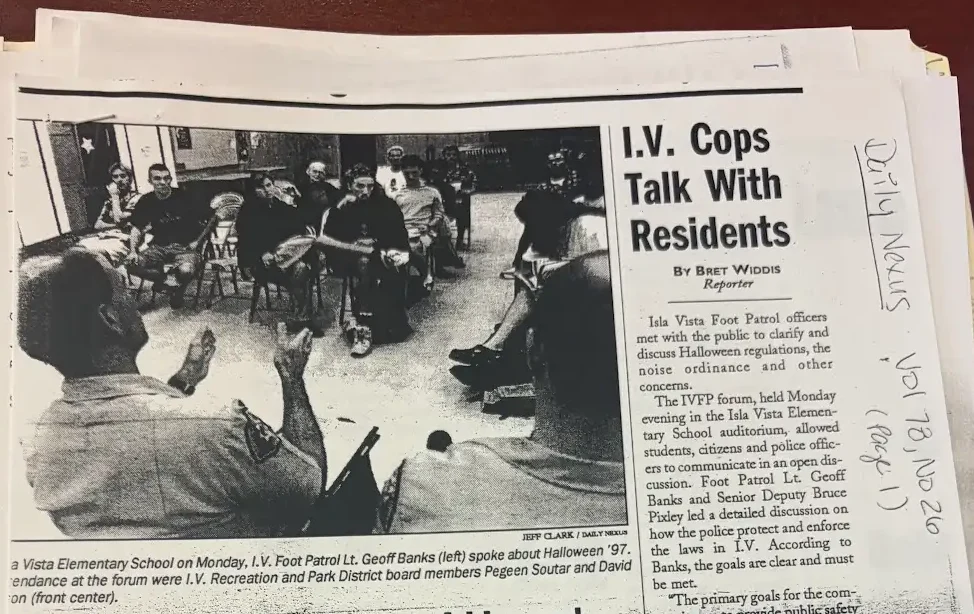
In 1997, police met with students before Halloween to discuss the law’s expectations and safe alternatives for celebrating as the Five-Year Plan neared its end. Halloween 1998, the first year after the Five-Year Plan ended, would set the tone for how police would continue to regulate holiday celebrations. Sgt. Mike Burridge of the Santa Barbara Sheriff’s Department assured the Daily Nexus that police presence would remain high that year. Police said they would maintain a zero-tolerance stance on enforcing the law, and that anyone found in violation would be cited. Sgt. Burridge noted that “This year will not look any different than it has the past few years.” Despite students’ anticipation about how police might respond, policy did not change, and all ordinances and regulations remained.
Isla Vista’s experience of Halloween changed dramatically throughout the 1990s. In the early years of the decade, parties grew increasingly rambunctious, spiraling out of control and driving students, faculty, and parents alike into genuine panic. In response, the middle of the decade saw a major police crackdown to destroy the Halloween party scene and restore order. The Daily Nexus recorded this turn as it happened: the paper that once warned students about the Halloween crowds ended the decade by teaching them their rights under arrest.
Despite the student pushback and unpopularity of these policies, the fall of UCSB’s infamous Halloween celebrations took shape in the 1990s and established a legacy of intense festivity policing that continues to be present in the Isla Vista scene to this day.. In turn, Halloween’s evolution in Isla Vista during the 1990s helped shift UCSB policing culture from standard call-and-response community policing to a permanent system of proactive surveillance, crowd control, and regulation that still oversees student activities today, from Halloween to Deltopia.
AUTHOR BIO: Dylan Loring is a 2026 graduate of the University of California, Santa Barbara, where he earned his B.A. in History of Public Policy and Law with highest distinction. As an aspiring legal scholar, he seeks to bridge his interests in historical research and legal studies through a career in law.