
PDF Version[1]
Introduction
In 1878, Chief Justice Morrison R. Waite delivered the Supreme Court’s opinion in Reynolds v. United States, declaring that polygamy was “almost exclusively a feature of the life of Asiatic and African people” until the establishment of the Mormon Church.[2] This judicial pronouncement crystallized decades of rhetorical strategy that had systematically portrayed Mormon plural marriage as an “Oriental” practice fundamentally incompatible with American democracy. The legal codification of this Orientalist framework marked the culmination of a complex process through which anti-Mormon activists transformed cultural prejudices into institutional action, fundamentally shaping both popular sentiment and federal policy toward religious minorities in nineteenth-century America. The effectiveness of this rhetorical strategy becomes particularly evident in the evolution of federal anti-polygamy legislation, from the 1862 Morrill Anti-Bigamy Act through the 1887 Edmunds-Tucker Act. By characterizing Mormon practices as fundamentally “Oriental,” anti-Mormon activists created legal mechanisms that treated the Mormon question as part of a broader campaign against foreign influences in American society. This process coincided with and reinforced growing nativist movements, as demonstrated by the parallel treatment of Mormon converts and Chinese immigrants in the late 1800s. Understanding this dynamic provides crucial insights into how nineteenth-century Americans constructed and maintained religious, racial, and cultural boundaries by opposing perceived “Oriental” threats.
This paper examines how anti-Mormon activists strategically deployed Orientalist rhetoric to delegitimize the Church of Jesus Christ of Latter-day Saints and its practice of plural marriage. Drawing upon Edward Said’s theoretical framework of Orientalism, the analysis demonstrates how critics deliberately characterized Mormon practices as “Oriental” to tap into existing American anxieties about Asian influences and cultural infiltration, particularly through comparisons to Turkish harems and Islamic polygamy. This rhetorical strategy proved particularly powerful because it operated simultaneously on multiple levels—religious, racial, and political—while coinciding with growing concerns about Asian immigration and European religious influences on American identity.
Through analysis of the literature of the period, legal documents, political cartoons, and public discourse, this research reveals how the strategic Orientalization of Mormon polygamy served three crucial functions: First, it provided legal justification for federal intervention in religious practices by framing polygamy as a foreign threat rather than a domestic religious issue. Second, it gave feminist critics a framework to attack plural marriage by drawing upon established narratives about Eastern female oppression. However, this rhetoric often overlooked Mormon women’s own articulations of autonomy within plural marriage. Third, it reinforced racial hierarchies by suggesting that engagement in “Oriental” practices compromised Mormons’ claims to whiteness, despite their European ancestry.
The paper proceeds in five parts. It begins by examining the theological and social innovations of early Mormonism that made it particularly susceptible to Orientalist critique. The second section analyzes how federal legislation and judicial decisions increasingly relied on Orientalist frameworks to justify intervention in Mormon religious practices. The third section explores how anti-Mormon rhetoric intersected with broader anti-Asian sentiment and immigration restrictions. The fourth section examines how both critics and defenders of plural marriage deployed competing feminist frameworks, revealing complex questions about women’s autonomy and religious freedom. The final section considers the broader implications of Mormon Orientalization for understanding how American society managed perceived threats to cultural hegemony, with notable parallels to the contemporary discourse surrounding religious minorities and immigration. Understanding this historical dynamic provides valuable insights into the broader patterns of religious and cultural discrimination in American society while highlighting the persistent role of Orientalist discourse in shaping American responses to religious and cultural differences.
Theological Innovation and Social Order in Early Mormonism
The Church of Jesus Christ of Latter-day Saints emerged during the Second Great Awakening, a period of intense religious fervor and innovation in American life. In 1830, Joseph Smith founded the LDS Church in upstate New York based on his “translation of a set of gold plates delivered by an angel.”[3] While the founding of the church initially appeared as just another manifestation of the era’s religious enthusiasm, the movement quickly distinguished itself through radical theological and social innovations. Early Mormon teachings, the church’s rapid growth, and distinctive practices challenged fundamental Protestant assumptions about the relationship between God and humanity, the nature of religious authority, and the structure of American society itself. The movement’s rapid growth alarmed Protestant leaders who saw its success as a threat to traditional religious authority, provoking suspicion and hostility. Facing persecution, the Mormons migrated westward, moving from New York to Ohio, Missouri, and Illinois. After Joseph Smith died in 1844, his successor, Brigham Young, led the Mormons to the Salt Lake Valley in Utah in 1847, seeking religious freedom in an isolated region while further reinforcing perceptions of the group’s separateness from American society.[4]
Central to Mormonism’s appeal was its rejection of Protestant individualism in favor of hierarchical authority and communal organization. The church’s assertion of continuing revelation through a living prophet, the introduction of new scripture in the Book of Mormon, and the claim to restored priesthood authority represented direct challenges to Protestant religious autonomy.[5] These theological innovations were accompanied by ambitious social experiments, including communal economic arrangements, hierarchical church governance, and eventually, plural marriage.[6] While the exact time when Joseph Smith felt compelled to practice polygamy remains unclear, W. W. Phelps recollected that Joseph Smith specifically referenced Abraham and Jacob around 1834, revealing his intentions for plural marriage.[7] Referencing Old Testament patriarchs, Joseph Smith positioned plural marriage as a restoration of ancient biblical practices rather than an innovation. This theological framing proved crucial, as it allowed Mormons to present polygamy as a return to divine patterns rather than a departure from Christian tradition. It was not until 1852 that Orson Pratt, a prominent Mormon apostle, publicly claimed the practice of polygamy on behalf of the LDS Church.[8] This announcement came at a particularly complex moment in American religious and social history. The practice emerged against the backdrop of various other alternative marriage arrangements being explored by religious and utopian communities, including the Oneida Community’s complex marriage system and the Shakers’ celibacy.[9] However, Mormon polygamy proved especially threatening to Protestant sensibilities because it combined religious authority, territorial autonomy, and a rapidly growing convert base.
Legal Framework and Federal Response
The characterization of Mormon practices as “Oriental” provided both the language and justification for concrete federal action against the church, particularly targeting the practice of plural marriage. By casting Mormonism as a threat to American civilization, anti-Mormon activists created a legal rationale that paralleled existing policies toward other “foreign” influences. The first major legislation, the Morrill Anti-Bigamy Act of 1862, operationalized these fears by not only criminalizing bigamy but specifically targeting Mormon institutional power, disapproving and annulling all Utah territorial laws that “establish, support, maintain, shield, or countenance polygamy.”[10] The Act’s language notably mirrored contemporary legislation dealing with other “Oriental” threats, treating Mormon institutions as alien entities requiring federal control.
The watershed moment came in the 1879 Reynolds v. United States decision, which transformed cultural prejudice into constitutional doctrine. Chief Justice Waite’s opinion explicitly codified Orientalist rhetoric into constitutional law, declaring that “polygamy [led] to the patriarchal principle” and despotism and linked it to “Asiatic and African peoples.”[11] The court concurred with the longstanding Orientalist anti-Mormon sentiments, asserting that polygamy and theocracy were inherently connected to the “more ‘backward’ races of the East” and entirely unacceptable within the United States.[12] Legal scholar Sarah Barringer Gordon interprets the decision as the Supreme Court believes that “polygamy would ‘fetter’ the people,” “invading surrounding states and territories, and ultimately compromising democracy.”[13] By characterizing plural marriage as inherently despotic and Eastern, the Court provided constitutional justification for federal intervention while establishing a crucial precedent: practices deemed “Oriental” could be restricted without violating religious freedom, as they represented a fundamental threat to American democratic institutions.
The Edmunds Act of 1882 translated these constitutional principles into expansive enforcement mechanisms. Beyond criminalizing unlawful cohabitation, the Act created a comprehensive system of civic exclusion by barring polygamists from jury service, voting, and holding public office.[14] It established new enforcement tools, including special commissioners and expanded prosecutorial powers, creating an administrative apparatus specifically designed to identify and prosecute those engaging in “Oriental” practices. The Edmunds-Tucker Act of 1887 represented the culmination of this legal evolution, deploying federal power in unprecedented ways. The Act’s requirements for anti-polygamy oath, disenfranchisement of women, and dissolution of the Mormon Church as a legal entity demonstrated how Orientalist fears justified extraordinary federal intervention.[15] The law’s provision exempting only property used “exclusively for purposes of the worship of God” reflected a deeper legal distinction between acceptable “American” religious practice and dangerous “Oriental” institutions.[16] This selective recognition of religious legitimacy provided a legal framework for dismantling Mormon economic and social structures while nominally protecting religious freedom.
This legal evolution reveals how Orientalist rhetoric transformed from cultural prejudice into institutional action. By categorizing Mormon practices as fundamentally “Oriental,” legislators and courts created mechanisms that treated the Mormon question not merely as a domestic religious issue, but as part of a broader campaign against foreign influences in American society. This framework proved particularly effective because it operated simultaneously on religious, racial, and political levels, providing comprehensive justification for federal intervention while reinforcing Protestant cultural hegemony.
Anti-immigration Sentiments and Oriental Connections
The anti-Mormon sentiment of the nineteenth century emerged within a broader context of nativism and xenophobia that positioned both Asian immigrants and Mormon converts as threats to American cultural and racial identity. This period saw unprecedented waves of immigration that triggered growing anxiety about foreign influences on American society. The convergence of anti-Mormon and anti-Asian sentiment reveals how nineteenth-century Americans constructed racial and religious boundaries through opposition to perceived “Oriental” threats.
The arrival of Chinese immigrants during the Gold Rush and the construction of the transcontinental railroad coincided with growing concerns about Mormon immigration and conversion. An 1870 article in The New York Times titled “The Chinese in the American Labor Market” exemplified the Chinese exclusion movement by portraying Chinese immigrants as threats to American labor and social norms. Workers claimed their interests were “jeopardized,” asserting that the issue extended beyond low wages to the immigrants’ “habits of life” and their “notions touching the moral laws,” which were both deemed “objectionable to American society.”[17] These same arguments about moral and cultural incompatibility were consistently deployed against Mormon communities, with critics like popular anti-Mormon writer C. C. Goodwin describing the LDS Church as “a foreign kingdom… guided and controlled by foreigners.”[18] Building on this fear, Nayan Shah argues that nativist groups intensified their campaign against Chinese immigration and perceived empire-building in the West by emphasizing the “filthy” household practices and “irregular” domestic economies of San Francisco’s emerging Chinatown.[19]
The intersection of racial and religious prejudice found vivid expression in popular media of the era. The Comic History of the United States captured this conflation in its cartoon “A Mormon Family Out for a Walk,” which depicted a Mormon patriarch leading a procession of wives and children from their homestead. The wives are portrayed with deliberately varied racial features and cultural marks: one drawn as a stereotypical black woman, one in Asian attire, and another suggesting Native American or Pacific Islander descent. The placement of this diverse group of wives in a quintessentially American pastoral setting—complete with a traditional homestead in the background—serves to highlight what critics saw as Mormonism’s corruption of American domestic ideals. Such imagery suggested that mainstream Americans at the time believed that polygamy not only represented moral degradation but threatened the very racial hierarchy that they sought to preserve. By portraying Mormon plural marriage as tied to racial mixing and foreign practices, anti-Mormons tapped into deeply rooted American fears about racial purity and cultural contamination in an era of national identity formation.
These anxieties about racial and cultural contamination intensified as both Asian immigration and Mormon converts from Europe increased, creating a dual threat narrative that linked foreign religious influence with foreign racial presence. Studies indicate that, by 1870, 67.9% of Utah residents aged twenty-five and older were born outside the United States, fueling fears about the territory becoming a foothold for foreign influence.[20] Nativists viewed both Catholicism and Mormonism as “religious heresy” and “a troubling centralization of religious authority.”[21] Critics deliberately conflated Mormon converts with Asian immigrants, portraying both groups as vectors for “Oriental” practices that could corrupt American society. This rhetoric proved particularly powerful because it operated simultaneously on religious, racial, and political levels – presenting Mormonism as a comprehensive threat to Protestant American identity.
The legal response to these perceived threats posed by both Chinese immigrants and Mormon polygamists reveals striking parallels in how the U.S. government employed civic exclusion to define the boundaries of American belonging. Passed in the same year, the Chinese Exclusion Act of 1882 and the Edmunds Act of 1882 both arose from moral panic over cultural and racial “otherness.” The Chinese Exclusion Act explicitly declared that the immigration of Chinese laborers “endanger[ed] the good order of certain localities within the territory thereof,” framing them as a threat to social stability, using vague legal language to justify exclusion based on perceived cultural or racial incompatibility.[22] Similarly, the Edmunds Act criminalized “unlawful cohabitation” and disenfranchised anyone engaged in polygamy, effectively rendering them civic aliens within the nation.[23] Both laws reflected anxieties about foreign moral systems threatening Protestant cultural hegemony and employed parallel enforcement mechanisms. The Edmunds Act’s creation of special commissioners to identify and prosecute polygamists mirrored the Chinese Exclusion Act’s establishment of immigration inspectors and deportation procedures. This institutional parallelism demonstrates how nineteenth-century Americans went beyond mere fear of foreign invasion and used the law to domesticate and criminalize perceived internal threats by aligning them with broader narratives of Oriental corruption and cultural degeneration.
The Orientalist Framework
The process of othering Mormonism in nineteenth-century America positioned Mormon religious and social practices as not merely different but as foreign and even threatening to American values and identity. The concept of Orientalism, as theorized by Edward Said, provides a crucial framework for understanding how anti-Mormon activists deployed Eastern imagery to marginalize and target Mormons, undermining their legitimacy in nineteenth-century America.[24] Said demonstrates how Orientalism operates through what he calls “imaginative geography,” in which cultures impose corrections on raw reality, transforming unfamiliar elements into manageable units of knowledge. Through this process, the West created fixed boundaries between itself and an imagined “Orient,” developing a vocabulary and set of representations that served to define Western identity through opposition to an Eastern “other.”[25]
As Said argues, the common habit of categorizing a familiar space as “ours” and an unfamiliar space beyond as “theirs” in one’s mind is a way of making geographical distinctions “entirely arbitrary.”[26] This practice acquired objective validity through repetition and institutional authority, despite its constructed nature. Anti-Mormon writers employed this same process of “Orientalization,” deliberately associating Mormon practices with Oriental “otherness” to position Mormonism outside the boundaries of acceptable American religious expression.[27] Similar to Said’s statement about how different types of “suppositions, associations, and fictions appear to crowd the unfamiliar and strange space,” nineteenth-century Americans crowded their conception of Mormon territory with exotic and threatening associations.[28] The Utah Territory became a space that required “dominating scrutiny” from the American mainstream, characterized by what Said terms “mysteriously attractive” but the opposites of “what seem to be normal values.” This imaginative geography transformed Utah into an internal Orient within America’s borders– a space simultaneously fascinating and dangerous, requiring both inspection and control. The perceived threat of Mormon difference, particularly through practices like polygamy, parallels Said’s observation that “rationality is undermined by Eastern excesses,” as anti-Mormon writers positioned Mormon practices as contradictory to American democratic and Christian values.[29]Crucially, Said emphasizes that Orientalism does not merely demonize; it also fascinates. While anti-Mormon literature painted the faith as morally decadent and politically subversive, Mormonism also attracted converts drawn to its promise of restored ancient Christianity, prophetic authority, and communal renewal. Its allure lay precisely in its difference: it offered an alternative to the perceived spiritual emptiness or fragmentation of mainstream Protestantism. This duality of fascination and fear made Mormonism especially threatening to the Protestant establishment. In this sense, the imaginative geography of anti-Mormon discourse did not simply exclude Mormonism from American identity—it reimagined it as an exotic spiritual competitor that had to be subdued.
However, viewing the Mormon Question solely through an Orientalist lens risks oversimplifying the complex web of social, political, and religious factors that shaped American attitudes toward Mormonism. Considering Mormonism only in terms of Orientalization could lead to mischaracterizing it purely as a colonialist discourse and portraying Mormons as solely colonized subjects.[30] In fact, in the colonization process of the American West, Mormons were at least as much agents as they were subjects colonized by “a repressive federal government,” particularly how the Mormon church faced discrimination while participating in the displacement of Native American populations and the broader project of American expansion. [31]
The Perceived Oriental Connections
The Orientalization of Mormonism manifested most powerfully through deliberate comparisons between Mormon leaders and Islamic religious figures, and through the characterization of Mormon territories as Eastern spaces. John C. Bennett, who left the LDS Church in 1842, published The History of the Saints; or, An Exposé of Joe Smith and Mormonism, directly comparing Mormonism and Islam, claiming that Joseph Smith “closely resembles his master and model, Mahomet,” especially “the secret regulations he has formed for directing the relations of the sexes.”[32] This characterization drew upon long-standing Protestant prejudices against Islam while questioning Mormon claims to divine revelation and Smith’s authenticity. In response, Smith declared in 1838 that he would become the “second Mahomet” if his enemies could not “let him alone.”[33]
The Mormon migration to Utah further reinforced perceptions of the group’s perceived isolated and foreign nature. The desert landscape of Utah itself became evidence of Mormonism’s supposedly “Asiatic” characteristic, with critics drawing parallels between Mormonism and Middle Eastern societies. Richard V. Francaviglia asserts that the “topography of the area surrounding Utah Lake and the Salt Lake Valley” was instrumental in the process of “Orientalizing the Intermountain West.”[34] Nineteenth-century observers imagined “Mormon geography transformed into Oriental geography” and “Saints into blindly devout Muslims or ‘lustful Turks.’”[35] Popular travel writer Sarah Jane Lippincott was reminded of Palestine when she visited Utah, noting that the entire region had “a singularly foreign aspect” to it.[36] Moving to the Rocky Mountain West in the 1840s, the Mormons restructured “a large portion of the American West as the Near East almost overnight.”[37] Sir Richard Burton, a British explorer and writer, likewise found Salt Lake City to be “somewhat Oriental,” more similar to an “Asiatic” settlement rather than an American one.[38] These associations, or rather imaginations, between Utah and the Oriental landscape suggested the belief that Mormon settlement represented a form of Eastern colonization within American borders.
The practice of plural marriage, defined “in exotic and Oriental terms” by J. Spencer Fluhman, became the most potent symbol of Mormonism’s supposed “Oriental” character.[39] In the minds of most Americans, polygamy was an ancient Oriental practice, something that Western civilization and “proper Christianity” had triumphed over “in its enlightened march toward liberty and democracy.”[40] This perception of historical progress positioned Mormonism as regressive and anti-modern. Quoting from Appleton’s Magazine, The New York Times claimed in their 1881 issue that monogamy and polygamy “have always been divided by race and section,” one being occidental and the other Oriental.[41] This racial and geographical division served to create a clear binary between acceptable Western practices and “foreign” Mormon customs. Similarly, Francis Lieber claims that the historical and actual distinction between monogamy and polygamy is “between European and Asiatic humanity,” framing people’s minds and moulding their feelings.[42] By establishing this stark cultural divide, anti-Mormon writers could effectively “other” Mormon practices as un-American. Orientalist descriptions of Mormon polygamy assumed a shorthand that racializes polygamy and its practitioners as “not fully white, Christian, or civilized.”[43] The 1879 Reynolds decision codified this Orientalist framework into constitutional law.[44]
This dual emphasis on religious and racial otherness made the Oriental comparison especially potent. Mormon polygamy was viewed as “unnatural” for Americans, reinforcing its characterization as both political and racial treason that threatened white racial purity.[45] Popular media reinforced these associations through visual rhetoric, as seen in the 1858 Harper’s Weekly illustration titled “Affairs at Salt Lake City,” which described Mormon domestic life through an Orientalist lens. The cartoon presents two scenes depicting Mormon life in Utah through an Orientalist lens, with both panels mocking Mormon military and domestic arrangements. The first panel depicts a “Brigadier-General” of the Mormon Army delegating the care of his numerous wives before departure. In contrast, the second shows a “Major” distributing locks of his hair to his “devoted Wives.” The artistic choices deliberately employ Orientalist visual tropes to transform Mormon domestic practices into spectacles of foreign barbarism, creating parallels to Eastern despots while suggesting exotic religious practices.
The Deployment of Feminism
The feminist discourse surrounding Mormon polygamy reveals complex and often contradictory perspectives on women’s autonomy and religious freedom in nineteenth-century America. While anti-Mormon activists strategically deployed feminist rhetoric to attack plural marriage, Mormon women themselves articulated sophisticated defenses of the practice, highlighting how the same institution could be viewed as either oppressive or liberating depending on one’s cultural and religious framework.
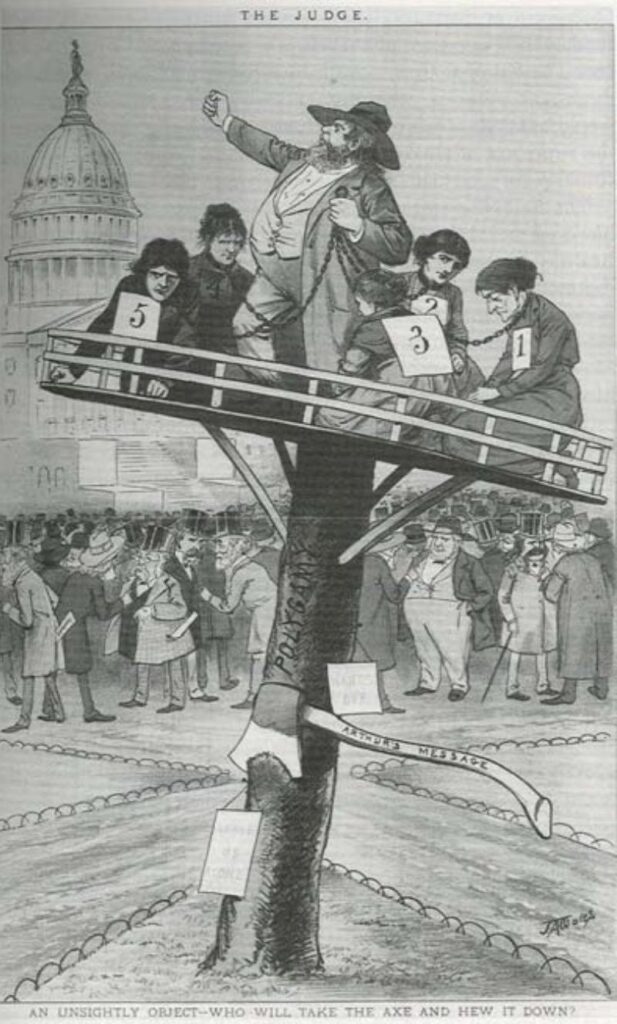
Anti-Mormons and anti-polygamists appropriated feminist rhetoric about women’s liberation and rights to strengthen their Orientalist critique. Justice Waite claimed that the real victims of Mormon polygamy were “innocent children” and “pure-minded women.”[46] This positioning of Mormon women as victims trapped in polygamous marriages was a powerful rhetoric in visual media. An example appears in an 1882 sardonic cartoon published in The Judge, which presents Mormon polygamy as a grotesque spectacle: a tree-like structure with numbered women in chains held by a Mormon patriarch against the backdrop of the Capitol building. The caption, “An unsightly object– who will take the axe and hew it down,” frames Mormon domestic arrangements as a monstrous growth requiring violent excision from the American body politic.
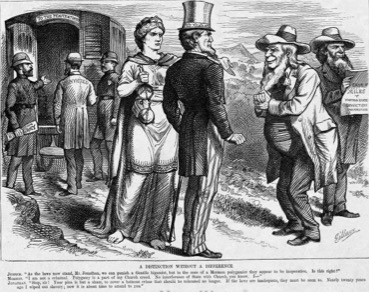
The supposed concern for women’s welfare served as a convenient moral cover for broader attacks on Mormon religious practices. Similarly, a cartoon published in Harper’s Weekly titled “A Distinction Without a Difference” juxtaposes criminal bigamy with Mormon polygamy. The illustration features a classical female figure wielding handcuffs—an allegorical representation drawing on traditional depictions of Justice or Liberty in nineteenth-century art. Her flowing robes and commanding presence symbolize moral authority, while the handcuffs suggest the need for legal enforcement. By positioning this female embodiment of justice against Mormon men, the cartoon aligns anti-polygamy sentiment with women’s rights, effectively transforming federal intervention into a feminist crusade.
However, this narrative of victimization contrasted sharply with the experiences articulated by many Mormon women themselves. Far from being passive victims, some elite plural wives “defended polygamy with strong feminist arguments” about the independence and freedom it offered, viewing it as a path to self-determination beyond male influence.[47] Many Mormon women articulated sophisticated defenses of plural marriage, arguing that it provided economic security, spiritual fulfillment, and opportunities for education and professional development while sharing domestic responsibilities.[48] In 1870, when the Cullom Bill threatened to strip polygamists of basic civil rights under the guise of women’s liberation, a group of Mormon women mounted a vigorous public response. They not only declared themselves “believers in the principle of plural marriage or polygamy” affirming their support and consent to polygamous marriages.[49] They pointed out how shared household duties allowed women to pursue education, participate in community organizations, and develop independent identities outside of marriage.[50]
In the minds of some, polygamy appeared to be beneficial. Apostle Parley P. Pratt concedes that “Mahometan institutions…have better morals and better institutions than many Christian nations,” indicating the Orient, in his perspective, was superior to the Occident.[51] Likewise, Apostle George Q. Cannon believed that polygamy “resulted in greater good” as it provided a way for men to fulfill their sexual desires within marriage, preventing them from going outside the bonds of matrimony, which should be the “sign of a given civilization’s corruption and decay.”[52] The instrumentalization of feminist rhetoric paralleled similar strategies used against other “Oriental” practices, where concerns about women’s rights became a pretext for Western intervention and control. For instance, similar methods were used in British colonial contexts, where worries about sati (widow burning) in India or foot-binding in China became justifications for British involvement.
Meanwhile, many non-Mormon women viewed “polygamous wives no better than prostitutes,” and became very devoted anti-polygamy crusaders.[53] On 6 October 1899, over 200 women led by Helen Miller Gould gathered at the American Female Guardian and Home for the Friendless, protesting against the seating in Congress of Brigham H. Roberts, Representative from Utah, “a man who advocate[d] and practices polygamy,” vowing that they would not rest until Roberts was removed from Congress.[54] Miss Gould denounced that polygamy attacked the “sanctity of home life,” passionately iterating that America would be “sad indeed to see a man who stands for the Oriental harem” seated among the lawmakers.[55]
The nation’s fate and morality appeared to hinge on the conflict between polygamy and monogamy, with women caught in the middle. Anti-polygamy activists appropriated feminist language to advance broader cultural and religious agendas, while Mormon women’s own voices were often overlooked or dismissed. This dynamic demonstrates how discussions of women’s rights could be strategically deployed to justify religious and cultural suppression, even as women themselves articulated more nuanced perspectives on religious freedom and personal autonomy. The complexity of this feminist discourse challenges simplistic narratives about polygamy as either purely oppressive or purely liberating, suggesting that nineteenth-century women engaged with plural marriage in diverse ways, shaped by their religious beliefs, social status, and personal circumstances.
Racial Undertones
The racialization of Mormon practices through Orientalist rhetoric played a crucial role in reshaping nineteenth-century American definitions of whiteness, revealing how racial identity in nineteenth-century America was determined not just by ancestry or appearance, but by conformity to Protestant cultural norms. Anti-polygamists argued that polygamy had origins in Islamic and Asian cultures, suggesting it was fundamentally at odds with American values.[56] The legal system’s treatment of Mormon polygamy contributed significantly to evolving definitions of whiteness in American jurisprudence, effectively creating a new category of “racial treason,” whereby white Americans could compromise their racial status through participation in practices deemed “Oriental.” This racialization of religious practice reflected broader nineteenth-century beliefs that Anglo-Saxon religious liberty was “a racial trait,” with Anglo-Saxons positioned to “uplift large parts of the globe” through their superior Protestant institutions.[57] As Gordon observes, following the Civil War, “the racial overtones of antipolygamy rhetoric migrated away from slaveholders and onto those who had been enslaved,” a shift that reinforced the idea that polygamy, and by extension, sexual deviance, was inherently non-white.[58] This rhetorical and legal displacement shows how polygamy functioned as a racial boundary marker: it not only delegitimized Mormon religious differences but also extended long-standing associations between Blackness, sexual disorder, and unfitness for citizenship to other non-conforming groups. In doing so, the state reasserted whiteness as a moral, disciplined, and monogamous ideal, further entrenching its association with national belonging.
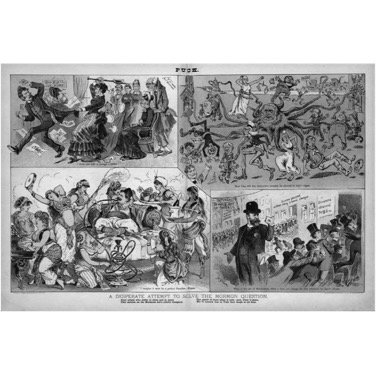
The racialization of Mormon practices is powerfully illustrated in an 1882 Puck Magazine cartoon titled “A Desperate Attempt to Solve the Mormon Question.” The cartoon’s most revealing panel depicts a Mormon domestic scene as an Oriental harem, complete with hookah pipes, exotic clothing, and lounging figures in a crowded, decadent interior. Titled “I Imagine It Must be a Perfect Paradise,” this scene deliberately employs Orientalist visual tropes to present Mormon life as thoroughly Oriental, “something unimaginable in America, and certainly not Christian.”[59] The illustration’s overall structure, moving through scenes of increasing social chaos, encapsulates how outsiders envisioned Mormons not only as practitioners of Eastern customs but as an existential threat to Western civilization itself. By presenting Mormon life through Orientalist visual tropes, the illustration suggests that engaging in polygamy could transform white Americans into racial others.
Furthermore, these comparisons extended beyond mere domestic arrangements to suggest broader patterns of social and political despotism. Some critics sarcastically put that Mormon immigrants did not come to America “in the love of republicanism” or “the admiration of American institutions;” instead, they came “in the confident expectation of assisting to subvert them [Protestants]” and that they came “not to America but to Zion.”[60] Lieber agreed that polygamy was “simultaneously despotic and antinomian,” claiming that Mormons were disdainful of “the ideal of republicanism.”[61] The “theo-democratic” nature of Mormonism— Joseph Smith’s concept of divine rule that positioned God’s voice as dictating the parameters of democratic participation—was threatening America “beyond the social contract that mediates consent within U.S. civil law.”[62] This critique aligned with broader expectations that “groups subjected to Anglo-American dominance were supposed to give up their unhealthy attachment to various forms of religious despotism,” positioning Mormon resistance to such conformity as evidence of their inherent opposition to American civilization.[63] The Oriental framework created a more fluid understanding of race that paradoxically made whiteness both more exclusive and more precarious, dependent not just on ancestry but on the continuous demonstration of Protestant cultural conformity.
Nevertheless, focusing primarily on how critics deployed Oriental comparisons might inadvertently overlook how Mormons themselves responded to, resisted, or even occasionally embraced these characterizations in articulating their own religious and cultural identity, suggesting the need for a more nuanced understanding of how Orientalist discourse operated alongside other rhetorical strategies and forms of resistance.
Implications
The Orientalization of Mormonism reveals broader patterns in how Western societies construct and manage perceived threats to cultural hegemony. The legal precedents established through anti-Mormon legislation and jurisprudence had far-reaching implications for American approaches to religious and cultural differences. The impact of racial recategorization extended beyond the Mormon community, contributing to broader jurisprudence about race, citizenship, and cultural conformity in American law. A key example of this framework appears in the writings of Congregationalist minister Josiah Strong, who portrayed Anglo-Saxon religious liberty not only as a civic ideal but as a “racial trait,” reinforcing the perceived superiority of the Anglo-Saxon race.[64] This conflation of religious and racial identity created a legal and cultural precedent wherein deviation from Protestant norms could signal racial otherness. As a result, courts began to treat certain religious and cultural practices as markers of race, effectively expanding the range of groups vulnerable to discriminatory treatment. This racialization of religious conformity laid the groundwork for a system in which citizenship rights could be challenged based on cultural, not just biological, whiteness.
The Mormon case paralleled British imperial strategies but differed in distinct ways. While British colonizers often depicted colonized peoples as primitive and sensual, highlighting practices like polygamy, caste systems, or tribal rituals as evidence of their “inferiority” and justification for colonial control, American Protestants adopted similar rhetoric to contain a perceived internal threat. In both cases, accusations of “Oriental” despotism, sexual degradation, and religious fanaticism served to justify institutional intervention and control, emphasizing the necessity of Christianizing and Westernizing influences and domination. However, the Mormon case was distinctive in targeting a predominantly white, Western religious group, demonstrating how Orientalist discourse could be flexibly deployed beyond its original colonial context. As Fluhman notes, “(h)eresy was in fact a hard-earned achievement for nineteenth-century Mormons.”[65] The “achievement” was that Mormonism came to be acknowledged as a genuine and distinctly American religion, but one that was fundamentally mistaken. This transformation from “Oriental threat” to mere “American heresy” illustrates how the boundaries of religious acceptability shifted over time, yet the underlying patterns of exclusion remained intact.
These historical patterns of religious and cultural othering persist in contemporary American society. The rhetorical strategies used to marginalize Mormons in the nineteenth century find striking parallels in the modern discourse surrounding Muslim Americans, particularly in how religious practices are framed as fundamentally incompatible with American values. Just as nineteenth-century critics portrayed Mormon polygamy as evidence of “Oriental” despotism, contemporary anti-Muslim rhetoric often focuses on religious practices and family structures as markers of cultural incompatibility, especially after 9/11. Post-9/11 surveillance programs targeting Muslim communities and legal challenges to Islamic family law practices echo the nineteenth-century logic that “foreign” religious practices require special government oversight and restriction.[66] Similar patterns emerge in debates over immigration, where certain groups are characterized as inherently threatening to American social order, echoing earlier fears about Mormon converts and Chinese immigrants as vectors of cultural corruption. These rhetorical strategies reflect a broader Protestant determination to maintain control over definitions of American identity and citizenship.
This binary opposition also reveals broader implications about Protestant American identity and the complex dynamics of religious and cultural exclusion. The Orientalization of Mormonism both reflected and affirmed fundamental anxieties about Protestant dominance, maintaining religious and cultural hegemony in America, while demonstrating how cultural rhetoric and institutional actions worked together to define the boundaries of acceptable American religious practice. This fear is most clearly manifested in the sustained opposition to Utah’s admission as a state. Protestant opposition to Utah statehood stemmed from deep suspicion that Mormon compliance with federal demands, particularly regarding polygamy, was merely tactical rather than genuine.[67] These critics feared that once Utah achieved statehood, Mormons would abandon their apparent accommodation with American norms and instead use their new political authority to advance their religious agenda at the national level.[68] An article published in The New York Times in 1854 titled “The Mormons in Utah” by Ferris asserts that Utah was chosen “for the purpose of founding a nation distinct from all others.”[69]
The relationship between the Orientalist rhetoric and discriminatory policies continues to form a self-reinforcing cycle. Public discourse that characterizes religious or cultural minorities as “other” helps justify restrictive measures and government intervention, while these policies in turn legitimize and strengthen the characterizations. This dynamic is visible in contemporary debates over religious freedom, immigration policy, and national security, where cultural and religious differences are often framed as threats that require institutional responses. The historical example of Mormon Orientalization thus provides valuable insight into ongoing processes of cultural exclusion and the complex interplay between widespread prejudice and institutional action in American society, creating a powerful framework that both reflected and shaped American attitudes toward religious and cultural differences well into the twentieth century and beyond.
Conclusion
This examination of anti-Mormon rhetoric through the framework of Orientalism reveals several significant insights about nineteenth-century American identity formation and its continued relevance today. The characterization of Mormonism as “Oriental” served multiple purposes: it provided a framework for justified aggressive federal actions, the deployment of feminist rhetoric, and reinforcement of racial hierarchies. The strategic deployment demonstrates how nineteenth-century Americans defined themselves not just by what they were, but by what they were not. By framing Mormonism as “Oriental,” critics situated Protestant cultural norms as the authentic embodiment of American identity, effectively creating boundaries of belonging that extended beyond simple religious differences to questions of racial fitness and political loyalty.
The case of Mormon Orientalization illuminates how effectively cultural rhetoric can be transformed into institutional action when it resonates with existing anxieties. The evolution from anti-Mormon sentiment to federal legislation shows how cultural prejudices, once codified in law, can reshape the legal landscape for generations. The Supreme Court’s decision in Reynolds established precedents that extended far beyond the Mormon question to influence broader debates over religious freedom, cultural conformity, and citizenship rights. The Supreme Court’s decisions in Cantwell v. Connecticut (1940) and later cases restricting Jehovah’s Witnesses’ religious practices, and the Court’s ruling in Employment Division v. Smith (1990) regarding Native American peyote use, both drew upon Reynolds’ framework that certain religious practices could be subordinated to broader social interests.[70] Furthermore, the intersectional nature of anti-Mormon rhetoric reveals how nineteenth-century Americans constructed a complex hierarchy of belonging that operated simultaneously along religious, racial, and gender lines. The case demonstrates how whiteness in America was never simply about ancestry but required continuous performance of Protestant cultural norms. Similarly, the deployment of feminist rhetoric against plural marriage shows how concerns for women’s welfare could be strategically mobilized to justify federal intervention while dismissing women’s own articulations of religious and personal autonomy.
Beyond historical significance, this research offers a valuable lens for understanding contemporary dynamics of inclusion and exclusion in American society. The rhetorical strategies and legal mechanisms developed to marginalize Mormons established patterns that continue to shape responses to perceived cultural threats. The parallels between nineteenth-century anti-Mormon rhetoric and contemporary discourse surrounding religious minorities suggest a persistent American anxiety about cultural differences that manifests in surprisingly consistent ways across historical contexts. It challenges us to recognize how definitions of American identity have been constructed not just through affirmative values but through opposition to perceived foreign elements within. By understanding how the boundaries of belonging were drawn and enforced in the past, we gain crucial insight into ongoing processes of cultural exclusion and the complex relationship between popular prejudice and institutional action in American society. The case of Mormon Orientalization thus serves as both a historical lesson and a contemporary warning about how cultural rhetoric can be weaponized to justify discrimination against religious and cultural minorities, even in a nation founded on principles of religious freedom.
[1] Krystal Liu is a sophomore at Duke University double majoring in History and Economics. Her historical interests are broad, with a particular focus on East Asian history.
[2] Reynolds v. United States, 98 U.S. 145 (1878).
[3] Richard S. Van Wagoner, Mormon Polygamy: A History (Salt Lake City: Signature Books, 1989), p. 45.
[4] Richard S. Van Wagoner, Mormon Polygamy: A History, pp. 6-15.
[5] Richard S. Van Wagoner, Mormon Polygamy: A History, pp. 6-15.
[6] Richard L. Bushman, “Joseph Smith: Rough Stone Rolling” (Alfred A. Knopf, 2005), pp. 437-448.
[7] Richard L. Bushman, “Joseph Smith: Rough Stone Rolling,” pp. 437-448.
[8] “The Mormons in Utah,” New York Times, June 30, 1854.
[9] Edwin Gaustad and Leigh Eric Schmidt. The Religious History of America. 2004: pp. 139-161.
[10] Morrill Anti-Bigamy Act, U.S. Statutes at Large 12 (1862): pp. 501-2.
[11] Reynolds v. United States, 1878.
[12] Reynolds v. United States, 1878; Christine Talbot, A Foreign Kingdom: Mormons and Polygamy in American Political Culture, 1852-1890 (University of Illinois Press, 2013), p. 131.
[13] Sarah Barringer Gordon, “The Mormon Question: Polygamy and Constitutional Conflict in Nineteenth-Century America” (University of North Carolina Press, 2002), p. 24.
[14] Edmunds Act, U.S. Statutes at Large 22 (1882): pp. 30-32.
[15] Edmunds-Tucker Act, U.S. Statutes at Large 24 (1887): pp. 635-41.
[16] Edmunds-Tucker Act, U.S. Statutes at Large 24 (1887): pp. 635-41.
[17] “The Chinese in the American Labor Market,” New York Times, July 7, 1870.
[18] C. C. Goodwin, “The Political Attitude of the Mormons,” North American Review 132 (March 1881): p. 283.
[19] Nayan Shah, “Contagious Divides: Epidemics and Race in San Francisco’s Chinatown” (University of California Press, 2001), pp. 17-44.
[20] Lee L. Bean, Geraldine P. Mineau, and Douglas L. Anderton, “Fertility Change on the American Frontier: Adaptation and Innovation” (University of California Press, 1990), pp. 143-44.
[21] Talbot, A Foreign Kingdom, (University of Illinois Press, 2013), p. 86.
[22] Chinese Exclusion Act, U.S. Statutes at Large 22 (1882): pp. 58-61.
[23] Edmunds Act, U.S. Statutes at Large 22 (1882): pp. 30-32.
[24] Edward W. Said, “Orientalism” (Pantheon Books, 1978), pp. 163-206.
[25] Said, “Orientalism,” pp. 163-168.
[26] Said, “Orientalism,” p. 167.
[27] Said, “Orientalism,” pp. 163-206.
[28] Said, “Orientalism,” p. 168.
[29] Said, “Orientalism,” p. 170.
[30] Talbot, A Foreign Kingdom, (University of Illinois Press, 2013), p. 135.
[31] Talbot, A Foreign Kingdom, p. 135.
[32] John C. Bennett, “The History of the Saints; or, An Exposé of Joe Smith and Mormonism” (Leland & Whiting, 1842), p. 85, pp. 130-31.
[33] J. Spencer Fluhman, “An ‘American Mahomet’: Joseph Smith, Muhammad, and the Problem of Prophets in Antebellum America,” Journal of Mormon History 34, (2008): pp. 23-45.
[34] Richard V. Francaviglia, Go East, Young Man: Imagining the American West as the Orient (Utah State University Press, 2011), p. 91.
[35] W. Paul Reeve, Religion of a Different Color: Race and the Mormon Struggle for Whiteness (Oxford University Press, 2015), p. 222.
[36] W. Paul Reeve, Religion of a Different Color: Race and the Mormon Struggle for Whiteness, p. 222.
[37] Francaviglia, Go East, Young Man, (Utah State University Press, 2011), p. 93.
[38] Reeve, Religion of a Different Color, (Oxford University Press, 2015), p. 222.
[39] J. Spencer Fluhman, “A Peculiar People”: Anti-Mormonism and the Making of Religion in Nineteenth-Century America (University of North Carolina Press, 2012), p. 98.
[40] J. Spencer Fluhman, “A Peculiar People”: Anti-Mormonism and the Making of Religion in Nineteenth-Century America, p. 224.
[41] “Monogamy and Christianity,” New York Times, September 25, 1881.
[42] Francis Lieber, “The Mormons,” Putnam’s Monthly 5, (March 1855): p. 234.
[43] Metta Victoria Fuller Victor, “Mormon Wives: A Narrative of Facts Stranger than Fiction” (Derby and Jackson, 1856), p. 45.
[44] Reynolds v. United States, 1878.
[45] Martha M. Ertman, “Race Treason: The Untold Story of America’s Ban on Polygamy,” Columbia Law Review 19, (2009): p. 301.
[46] Reynolds v. United States, 1878.
[47] Reeve, Religion of a Different Color, (Oxford University Press, 2015), p. 225.
[48] Reeve, Religion of a Different Color, p. 226.
[49] Reeve, Religion of a Different Color, p. 225.
[50] Reeve, Religion of a Different Color, p. 226.
[51] Parley P. Pratt, “Late Persecution of the Church of Jesus Christ of Latter-day Saints” ( J. W. Harrison, 1840), p. 59.
[52] Reeve, Religion of a Different Color, p. 225.
[53] Reeve, Religion of a Different Color, p. 226.
[54] “Women Attack Mormonism,” New York Times, October 7, 1899; “An Anti-Mormon Crusade,” New York Times, October 27, 1899.
[55] “An Anti-Mormon Crusade,” New York Times, October 27, 1899.
[56] Reeve, Religion of a Different Color, p. 228.
[57] Ryan P. Jordan, Church, State, and Race: The Discourse of American Religious Liberty, 1750–1900 (University Press of America, 2012), pp. 140-141.
[58] Gordon, “The Mormon Question,” (University of North Carolina Press, 2002), p. 24.
[59] Gordon, “The Mormon Question,” p. 24.
[60] John Hyde Jr., Mormonism: Its Leaders and Designs (W.P. Fetridge & Company, 1857), p. 315.
[61] Francis Lieber, “The Mormons: Shall Utah Be Admitted to the Union?” Putnam’s Monthly 5, (March 1855): pp. 229-231.
[62] Benjamin E. Park, The Kingdom of Nauvoo: The Rise and Fall of a Religious Empire on the American Frontier (Liveright Publishing Corporation, 2020), p. 200; Lieber, “The Mormons: Shall Utah Be Admitted to the Union?” Putnam’s Monthly 5, (March 1855): pp. 229-231.
[63] Jordan, Church, State, and Race, (University Press of America, 2012), p. 141.
[64] Jordan, Church, State, and Race, p. 140.
[65] Fluhman, “A Peculiar People,” (University of North Carolina Press, 2012), p. 18.
[66] In Hassan v. City of New York, a group of New Jersey Muslims sued the NYPD for religious discrimination after it was revealed that the department had engaged in widespread, suspicionless surveillance of mosques and Muslim-owned businesses. Similarly, FBI v. Fazaga involved a challenge to FBI infiltration of Southern California mosques, where the government invoked the “state secrets”privilege to avoid disclosing details of the program. Both cases reflect how Muslim religious spaces were subjected to exceptional government scrutiny in the post-9/11 era.
[67] Randall Balmer and Jana Riess, Mormonism and American Politics (Columbia University Press, 2016), p. 34.
[68] Balmer and Riess, Mormonism and American Politics, p. 34.
[69] “The Mormons in Utah,” New York Times, June 30, 1854.
[70] Cantwell v. Connecticut, 310 U.S. 296 (1940); Employment Division v. Smith, 494 U.S. 872 (1990).