
PDF Version[1]
Introduction
In the late nineteenth century, Mormon women actively advocated for their right to vote in the Utah Territory. The United States constantly scrutinized Utah’s religious practices, particularly polygamy, which they found opposed traditional American norms. After the Manifest Destiny era, many members of Congress sought to pass legislation that halted Mormon practices. In response, Mormon women organized politically to oppose such legislation, paving the way for broader civic engagement. As they gained political rights, they faced continued resistance from anti-polygamy activists who sought to marginalize their participation. During this period, Utah’s pursuit of statehood intensified political tensions and created new obstacles for Mormon women working to secure and defend their suffrage rights. By analyzing proposed anti-polygamy legislation and the collective activism of Mormon suffragists, this paper situates Mormon women as central political advocates who resisted societal and political pressures during Utah’s pursuit of statehood.
Contextualizing the Anti-Polygamy Bills
Since the middle of the nineteenth century, Protestant congressmen believed Mormon practices were un-American and attempted to limit polygamy activity. The governmental construction of the transcontinental railroad caused many Americans to migrate westward.[2] The West posed as an opportunity for economic expansion and trade. As more Americans settled into western territories, and particularly in Utah, Protestant Republicans found the Mormon lifestyle to pose challenges to traditional American ideologies. More specifically, Republicans believed the Latter-Day Saints Church’s involvement in Utah’s territory created a theocracy lacking proper democratic principles. Moreover, Republicans believed polygamy was “un-Christian” and un-American, and held their first national party on the grounds of abolishing the practice in Utah.[3] Interestingly, in the 1850s, lobbyists argued that polygamy deprived women of rights in an effort to limit the practice, showing the beginning attempts to restrict women’s rights in the name of protecting American ideals.[4] The Protestant perspective provides a framework for understanding America’s reservations about Mormon practices, particularly the persistent argument that women suffered under polygamy. Both these lines of thought are common themes that will reappear in this paper.
During the Civil War, the growing fears of Utah’s territorial practice led to Congress introducing the first Anti-Polygamy Bill. In 1862, Justin Morrill created the Morrill Anti-Bigamy Act, articulating how, “Mormons are quite as hostile to the Republican form of government as they are to the usual forms of Christianity.”[5] His belief that Mormons lack the same governmental ideologies and Christian beliefs underscores how Protestant values greatly influence traditional Americanism. The push to showcase how Mormons lacked the same principles helped pass the bill; however, it was difficult to enforce the bill because there was a vague legal definition of marriage, and Mormon jurists did not convict polygamists.[6] Mormons’ refusal to enforce the bill and persistence in their practices underscores their resilience to ongoing political pressure.
By the end of the decade, Congress tried to impose the Cullom Act, a bill similar to the preceding anti-polygamy bill. The Cullom Act, created in December 1869, emphasized that polygamists should lack suffrage or the ability to serve on a jury. Using the legal framework from the first bill, it reinforced the notion that cohabitation of multiple wives should be illegal, and the Act had greater punishments for practicing polygamists. Unlike the Morrill Act, the Cullom Act sought military power to enforce anti-polygamists’ jurisdiction.[7] The Cullom Act indicates the federal government’s continual intent to assert Protestant jurisdiction over the territory for its distinctive practices.
In response to the looming Cullom Act, Mormon women congregated in retaliation. In January of 1870, the Salt Lake City News platform, Deseret News, posted about the new bill. In response, Utahn women congregated and held a Ladies of Mass meeting to discuss their potential course of action: on 6 January 1870, the Utahn women unanimously voted against the bill and the need to protest in front of Congress.[8] During the meeting, the sisters discussed how they were pleased by Brigham Young’s encouragement of the Relief Society “to take a wider sphere of action.”[9] The emphasis on support from the Relief Societies, which were women-centered church circles, illustrates the power of the congregation and its active involvement in combating the anti-polygamy legislation. In addition, the conversation of suffrage surfaced during their efforts to combat religious intolerance: Eliza Snow noted how women should demand the right of franchise from the Government.[10] As Eliza Snow was a well-known leader in the religious sphere, her advocacy for enfranchisement demonstrates how women sought greater agency. As Mormon women began mobilizing to combat political legislation, they felt their growing political involvement warranted more rights within the territory.
In addition, the following week, an indignation meeting was held in Salt Lake City to protest on a broader scale. While advocating for religious freedom during The Great Indignation Meeting, five out of the fourteen advocates acknowledge how Mormon women should have suffrage, revealing how responses to anti-polygamy led to a conversation about equal rights.[11] The Great Indignation Meeting specified the importance of religious toleration and recognizing Mormonism as a marginalized community in America. More specifically, Eliza Snow talks explicitly about the tolerance of Jews and Christians and the importance of freedom.[12] Notably, news outlets across the nation sympathized with Mormons as the bill was extreme, and since there was significant backlash, the bill did not pass. [13] The Mormon women viewed the Indignation meeting as a media strategy to reach the broader United States and to have individuals understand their cause for tolerance.[14] The responses and continual debates illustrate how leading women mitigated societal pressures and political legislation. By broadcasting the importance of religious toleration, women used their spheres and power to limit the government’s infringement on religious rights and start the conversation of suffrage.
While Mormon women actively congregated in retaliation against the Collum Act, there were lingering ideas that women were incapable of controlling their political activity. For instance, during the Ladies of Mass Meeting, the Mormon women addressed how anti-polygamists felt women were coerced into polygamy and were incoherent. In response, the Mormon activist noted the importance of “not remaining silent beneath such a flood of falsehood,” illustrating the capability of advocating for themselves.[15] In addition, in 1869, Frank Leslie’s Illustrated Newspaper published a political cartoon that expressed a similar sentiment. The image showed Brigham Young front and center, leading women holding children, all with confused expressions. It appears they are on their way to a voting poll. There is a written sentence at the bottom of the image, “Female Suffrage. Wouldn’t it put a little too much power in the hands of Brigham Young, and his tribe?” The suspicion surrounding the granting of female suffrage in the territory reflected concerns that enfranchising women would only reinforce and perpetuate the practice of polygamy. However, the responses during the Great Indignation Meeting and Ladies of Mass highlight how Mormon Women actively advocated for their suffrage and exercised political agency.
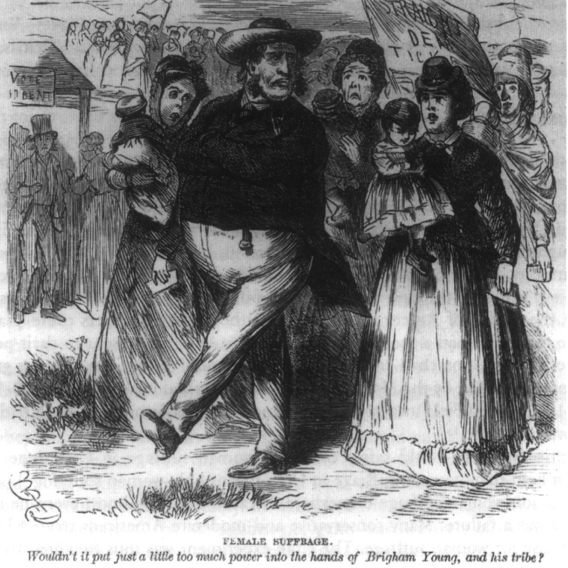
Initial Suffrage
During the 1860s, there was a resurgence of the Female Relief Societies, aiding the suffrage cause. The Relief Societies, as previously mentioned in the Ladies of Mass meeting, were female-centered groups in the Church that intended to help Mormon travelers. The Female Relief Society in the 1860s fostered a space for women to discuss their rights and responsibilities within the Church and in the secular world. Since the polygamous practice involves cohabitation with multiple wives, Mormon women felt a sense of independence as they were left alone to bear the responsibilities of a homeowner.[17] The Mormon women intended to seek some independence to aid with all their responsibilities; for example, Sarah Kimball promoted home craft manufacturing for women to gain economic autonomy, and Eliza Snow promoted programs for women’s self-improvement.[18] The use of Mormon women in political and religious activism helped exemplify their willingness to advocate for greater civic involvement and reform; the Relief Society aided a broader community of women.[19] As the Relief Society offered a sphere for women to gather and empower one another, there was an additional reason to advocate for suffrage, especially in a territory where they already had significant independence. Thus, women’s prominent leadership and community activism justified their argument for the extension of suffrage.[20]
In 1870, women gained the right to vote in Utah’s territory. Their political activism, church presence, and independent lifestyle led to a natural progression toward the discussion of female suffrage among the male territorial legislatures.[21] In addition, the polygamous lifestyle fostered independence for women, such as property management, the ability to legally sue, and pay taxes, causing suffragists to advocate for proper representation over their finances.[22]Consequently, in February of 1870, President Brigham Young organized the council members to advance the passage of women’s suffrage. The Women of the Mormon Church pamphlet argued how, in the religious sector, men gave Mormon women more of an equal playing field as they were eligible to vote and contribute to wide-scale religious discussion, justifying their ability for more secular rights.[23] Additionally, the pamphlet notes no opposition from the men on the council of the state legislature, arguing that they have interacted with the women of Utah for over 40 years in Church and civil life. As men began to view women as equals, it undermined the anti-polygamists’ narrative that women lacked agency. Interestingly, the pamphlet mentioned how the legislative council was waiting for a governor who was non-Mormon to approve the statute in 1870, illustrating biases for those not part of the Mormon culture. The non-Mormon legislature’s delayed support for universal suffrage highlights the challenges Mormon suffragists faced in confronting concerns from the secular community.[24] Furthermore, the Church pamphlet argued that women’s activism within the religious sphere was instrumental in securing suffrage, highlighting how Mormon women strategically mitigated societal and political pressures to expand their rights within Utah’s territorial framework.
Mitigating Suffrage on a National Scale and the Power of the Woman’s Exponent
The Mormon Suffragists began networking with the national movement and tried to help women in other parts of the country. The Suffragists Elizabeth Cady Stanton and Susan B Anthony stopped in Salt Lake City in June of 1871 and met the activists on their way to the Pacific Coast.[25] The importance of their visit shows a broader network of suffrage and how the conversations continued after the territorial gain. In addition to the suffragists casting a wider network, Lula Green Richards became the first editor of the Woman’s Exponent in 1872, which broadcast suffrage rhetoric and shared information about Utah with the rest of the United States.[26] In the first edition, Richards quotes Reverend James Freeman Clark for saying “that if it is an advantage to vote, then women ought to have it,” connecting her own argument, expressing: “We hope for a time when this immunity will be universally enjoyed by our pure-minded and light-loving sisters.”[27] Featuring Reverend Clark’s opinion in the magazine highlights how Utah’s religious values remained central to the fight for Mormon suffragism, and how community leaders’ support reflected both the importance of their insight and the role of religious tolerance in the movement. Additionally, in the first volume of the pamphlet, Reverend Clark notes the Utah Relief Society’s activities, and how local pioneers such as Eliza Snow connected with suffragists associated with the national cause.[28] The involvement of prominent religious leaders, such as Snow, underscores the continued importance of religious values within the broader suffrage movement. Additionally, the inclusion of Mormon practices, such as the Relief Society’s activities, demonstrates how the magazine’s content intersected with religious life, emphasizing how Mormon suffragists mitigated both religious and gendered pressures.
Additionally, the Exponent also touched on ongoing anti-polygamy legislation. Richards notes an “Anti-Mormon bill of Judge Bingham” seeking to advance in Congress, and Reverend Pierce, a Methodist clergyman, trying to “propose the extinction of polygamy.”[29]Interestingly, Reverend Pierce encouraged Gentile women to dress lavishly in hopes that it would influence Mormon women to do the same and make it “impossible for a man to support more than one wife, if even one.”[30] The clergy members’ initiative to make supporting multiple wives difficult shows an ignorance of the Mormon practices, since many women maintained economic independence. Moreover, the push for new legislation reflects how non-Mormons kept trying to lobby against Mormon practices despite repeated failed attempts. The Women’s Exponent’s direct disapproval of anti-polygamous claims demonstrates its efforts to combat political pressure while also advocating for a national cause.
In addition to Richards, Emmeline B. Wells was a huge proponent of religious and gendered activism. Wells became one of the main editors of the Women’s Exponent Magazine in 1877. She references a lot of Mormon rhetoric because she herself is Mormon, which provides more context for the biases of the Exponent magazine. Wells became a proponent of universal suffrage and represented Utah as a delegate and Vice President of the associated Territory within the National Suffrage Association’s movement.[31] In 1879, the national pioneers invited Wells to the national convention in Washington.[32] Wells, a central proponent of the cause, shows how the pioneering activists in the West aided all women, despite the internal Mormon focus.
The creation of the Anti-Polygamy Society
Utahn anti-polygamists attempted to disenfranchise Mormon women within the decade after they gained suffrage. For instance, anti-polygamists attempted to dissuade national suffragists from assisting the Utah women, hoping to discourage them from reinforcing Mormon practices.[33] In 1878, to take greater extremes, Non-Mormon Utahn women created the Anti-Polygamy Society.[34] The society intended to show how Mormon women were “suffering” under polygamy and that the country should help them refrain from those practices. For example, in 1880, there were local attempts to disenfranchise women, including an attempt to remove Utah women from the registrar, yet their actions were unsuccessful.[35] The intention to remove women from the local registrar reflects how they felt suffrage was the root cause of continual polygamy.
To broadcast antipolygamy rhetoric, the non-Mormon women in Utah created a monthly newspaper called the Anti-Polygamy Standard. The Protestant women intended to address how Mormon women suffered from polygamy.[36] For instance, the first article written in the Standard addresses how “conscientious women have been imposed upon, blinded and deluded, led to believe that wrong is right, and self-sacrifice duty,” aiding the idea that women were coerced into a lifestyle beyond their control.[37] Addressing the women as “blinded and deluded” portrays how the anti-polygamists viewed polygamy as an unconscious decision. In addition to the first article, one of the headlines titled “How Wives are Coerced into Giving Consent for Their Husbands to Enter Polygamy” further supplements the idea that Mormon women lacked genuine agency.[38] As the newspaper gained prominence, it became a new obstacle for Mormon suffragists in maintaining their rights.
The newspaper explicitly expressed concern that Mormon practices opposed American traditionalism. Not only did they believe the women were “deluded,” but also “un-American,” reflecting similar sentiments to early anti-polygamists. The first article also addresses “Christian Women of America” and asks, “What do you think of a system that has affected such a transformation in a naturally devout and religious woman?”[39] The calling of Christian women to analyze the Mormon lifestyle further shows how Protestant ideologies significantly affect Utah’s legislative environment. It also demonstrates the persistence of Protestant Republican beliefs (originating before the Civil War) that Mormonism deviated from accepted American values. In the latter half of the decade, Christian women shared a similar sentiment. The belief that polygamy is the opposite of American ideals greatly influences anti-polygamy activists to lobby against the Mormon practice. Another critical factor is that non-Mormons in Utah, possessing limited political traction, believed that disenfranchising women would advance their agenda, as they perceived Mormon women followed their husbands’ and the Church’s perspectives unquestioningly.[40]The gendered association that women lacked agency indicates the embedded stigma of patriarchal norms, coinciding with the societal pressures Mormon women faced to advocate for themselves.
More Legislation/Tensions of Anti-Polygamy
In response to greater anti-polygamy activism and the creation of the Anti-Polygamy Society, there was the introduction of another anti-polygamy bill. In 1882, lawmakers established the proposal of the Edmunds Act to prevent all polygamists from voting. The Edmunds Act intended to imprison or fine those found to have cohabited with multiple partners. The Act explicitly states that no polygamists “in any territory or other place the United States has jurisdiction, shall be entitled to vote in any territory or hold an election or be appointed to a title.”[41] The emphasis on disenfranchisement shows how there was a national shared hatred of polygamy, which caused the Mormon activists to advocate in retaliation. The January Convention of the National Women’s Suffrage Association held discourse about the potential for disenfranchisement and mapped out a resolution, showing how the women instantly combated political opposition.[42] Additionally, the House resolved the Edmunds Act because they deemed the proposition “a cruel display of power which lies in might alone” against the Utah women.[43] While the Act did not pass, the rhetoric it used still carried weight throughout the decade and was later used to protest and create new legislation.
As there was an ongoing attempt to disenfranchise women and illegalize polygamy, Utah was trying to gain statehood. In 1882, a Congressional council met to create a constitution for the new state. The legislatures welcomed three women into the constitution’s creation: Emmeline B. Wells, Sarah M. Kimball, and Elizabeth Howard.[44] The inclusion of women on the council supports the idea of progressivism in the Utah Territory. Not only did women legally have a voice, but they also had representation at the forefront of new legislation. Unfortunately, as Utah was pushing for statehood, the anti-polygamist activists were continually trying to remove citizenship rights for polygamists.
Interestingly, with the ongoing pressures of anti-polygamy, the suffragists began to feel uneasy about associating with Mormonism. In 1882, the Anti-Polygamy Standard wrote “An Open Letter to Suffragists,” encouraging them to understand their perspective against Mormon enfranchisement.[45] More specifically, the paper outlines that they are not opposed to universal suffrage but rather to allowing Mormons to vote. The letter includes how, if the ballot were “in the hands of intelligent and cultured American women,” they would not oppose suffrage.[46] It is important to note that the anti-polygamists associate “intelligent” women with Protestant values. They argue that suffrage “has brought no increased respect or power for women; it has only been another brand of shame for their brows.”[47] The argument that women’s suffrage perpetuated polygamy suggests an assumption that women had no control over their rights. The constant pressure from anti-polygamist and underlying Protestant beliefs indicates how Mormon women faced extreme difficulty maintaining their vote.
The direct address to National Pioneers has made the conventions contentious. Notably, during an 1884 National Convention, Susan B. Anthony interrupted a Mormon suffragist seeking support from anti-polygamist legislation.[48] As the National Pioneers intended voting rights to help “purify American society,” the increasing sentiment against polygamy made associating with Mormon women difficult.[49] When the Mormon activists tried to gain support at a New York Convention following the national one, Anthony stopped them again. They had a private conversation where she justified not endorsing polygamy, further demonstrating how anti-polygamy rhetoric affected suffrage activism.[50] Additionally, during that year, Woman’s Christian Temperance Union activist Angelina French Newman submitted a petition to revoke Utahn women’s suffrage. The petition, circulating in Methodist circles and beyond, received over 250,000 signatures in all parts of the country.[51] The growing tensions, dissociations from national suffragists, and thousands of signatures illustrate the brooding tension of Mormon suffragism, making mitigating societal pressures difficult.[52]
In addition to petitions and newspapers, there was a resurgence of another anti-polygamy bill. The Edmunds-Tucker Act used similar rhetoric of anti-polygamy from the Edmunds Act and included explicit language that disenfranchised all Utahn women from voting. Vermont Congressman George Edmunds argued that the bill intended to relieve women from voting in favor of a practice that keeps them in “a state of degradation.”[53] Since there was a sentiment that women were suffering under polygamy, disenfranchisement was intended to free them from suffering. In this context, it appears women never had control over their own vote or societal position in Utah, leading anti-polygamists to relieve women from their forced voting position. However, Mormon women felt they had political agency.
Mormon Suffragist Response
As the Edmunds-Tucker Act approached, national and local suffragists opposed the bill in the year leading up to the decision. In January 1886, the Women’s Exponent reprinted an article from the American Suffrage Association highlighting how Congress intended to revoke women’s voting rights, disregarding the “long settled law and practice.”[54] In March 1886, roughly 2,000 individuals met at the Salt Lake Theatre to protest the bill. The resolutions consisted of spirited rhetoric arguing against the illogical decision to withdraw rights that had been in place for 15 years. Specifically, the women challenged the anti-polygamist argument regarding coerced voting (which suggested Utahn women would vote in favor of polygamy) by asserting that the secret nature of the ballot ensured privacy and prevented undue influence, regardless of personal biases.[55] Additionally, the suffragists argued the unfair practice of a bill imposing on their relationships and how they should be able to “honor their sex.”[56] Although anti-polygamists believed men coerced women into certain voting practices, the response from Mormon suffragists demonstrated their autonomy over their political choices.
While anti-polygamists argued disenfranchising women would relieve them from suffering, Mormon activists thought the looming presence of the Edmunds Tucker Act was in response to the discomfort of Mormon practices and the illogical linkage of women’s voting choices. Nationally, suffragists in various states protested the bill, arguing that women should also retain their rights in Utah. Even though national suffragists limited Utah’s activists from advocating for polygamy at the convention, the Pioneers still strongly believed in their right to enfranchisement. A primary source from the Pioneers’ notes that national suffragists disapproved of anti-polygamist activism because they believed disenfranchisement would restrict universal freedoms.[57] Notably, in 1887, the National Convention appointed a committee that presented a memorial to the President urging him to veto any bills containing restrictions on voting rights.[58] The national response provides insight into how the potential for political exclusion provoked frustration among all suffragists and the continual efforts to combat political pressures.
Responses to the Edmunds-Tucker Act
Unfortunately, the Edmunds-Tucker Act was passed in Congress, but Mormon suffragists immediately advocated against their disenfranchisement. In response to disenfranchisement, the Women’s Exponent magazines consistently spread suffrage rhetoric and expressed concerns about their deprivation of rights. Within four months after the passage of the bill, one of the suffragists associated with the Women’s Exponent, S.A. Fullmer, posted an article expressing frustration with the unsound arguments made about disenfranchising women. Fullmer argues that the Constitution only revokes voting rights for those who commit treason. She defines treason as “levying war, or giving aid and comfort to the enemies of the United States” and proceeds to say how “Senators and statesmen of a great nation must be terrible cowards to be afraid that the women of Utah would “levy war against the United States.”[59] The author’s intent to hone in on what qualifies the government to revoke rights provides how polygamy is not within the constitutional boundaries of a crime. Fullmer articulates how the bill uses unsound arguments to disenfranchise women from biases against polygamy. The author also responds, “We claim to have a right untrammeled,” touching on religious tolerance.[60] Given that biases against polygamy fueled the bill’s passage, Fullmer’s focus on their First Amendment rights highlighted the frustration women experienced due to their loss of suffrage. The suffragists’ response to criminal activity illustrates their ongoing efforts to advocate for themselves and to refute societal pressures.
In addition to the Women’s Exponent, the suffragists connected with the National Association to protest against the new bill. In 1888, the National Association encouraged Utah delegates to create their own territorial association. More specifically, the pioneers appointed Emily S. Richards, Utah’s representative at the National Convention, to form a new union. Several preliminary meetings occurred within the Office of the Women’s Exponent, discussing the need for a territorial association, and leading to the eventual formation of the Utah Suffrage Association (created on 10 January 1889).[61] The Women’s Exponent, published on 15 January 1889, discussed the new association’s formation and noted how “all ladies interested in the cause of women’s enfranchisement and political advancement are cordially invited to be present and take part in the meeting.”[62] The Exponent’s encouragement of political involvement and community gathering shows how Mormon women took agency to combat their disenfranchisement.
In addition, the ongoing pressure against polygamy affected the logistics of the new territorial association. During the preliminary meetings, the women agreed to endorse leaders to the Utah Suffrage Association who were monogamous in an effort to limit societal disapproval. Although some leaders were in monogamous relationships, most women in the suffrage association were Mormon practitioners involved in polygamous relationships.[63] The significance of choosing monogamous Mormon women to lead the new association supplements the argument that Mormon women were constantly combating societal pressures.
Statehood Sacrifice and Continual Fight for Suffrage
As the Territory was aiming to gain statehood, the issues surrounding polygamy remained abundant. To combat congressional pressures of polygamy, the LDS Church dissociated with the practice.[64] In 1890, to ease the tensions of polygamy, President of the Church Wilford Woodruff wrote a manifesto released by the Church in October of 1890, stating how “laws have been enacted by Congress forbidding plural marriages, which laws have been pronounced constitutional by the court of last resort, I hereby declare my intention to submit to those laws, and to use my influence with the members of the Church over which I preside to have them do likewise.”[65] The word choice of saying he plans to “submit” to congressional law shows a forfeiting of the fight for polygamous acceptance. He accepts governmental authority rather than stating a willingness to abide by the Act. His intention to influence others to partake in monogamy provides the underlying pressure to conform to Protestant America. As a leader, he understands the importance of building a mass movement and recognizes that complying with congressional pressure could be strategically beneficial. Sacrifices, including religious practices, were necessary to gain congressional recognition of statehood.
While the Church began disassociating from polygamous practices, the Utah Suffrage Association was attempting to increase a greater awareness of suffrage. In the same year as the Church’s dissociation, women traveled along the territory to gain more members to associate with the Utah Suffrage Association.[66] As the suffragist gained more traction, they learned to use songs as a tactic to reinforce suffrage rhetoric: in 1891, the Utah Suffrage Association created a songbook to compile different tunes that helped their agenda.[67] The advocates use LDS hymns as song tunes to make them catchier. The integration of LDS hymns into their efforts highlights how central religious sentiment was to Utah’s suffrage cause. In addition, the songs discuss the need for equality; for instance, one of the songs, written by Emily H. Woodmansee, named “Equal Rights,” encourages women to advocate. Woodmansee argues that the United States is a land of liberty and that women must obtain their rights. She argues, “Why should women still be banned? Virtual Slaves, in freedom’s land?”[68] Just as enslaved people were subjected to authority, the disenfranchisement of women made them feel like they were part of a system that fundamentally misrepresented them. This comparison underscores their continual effort to regain enfranchisement.
Pressures of Statehood and Reintroducing Suffrage
While advocating for universal suffrage, the Territory also sought statehood. In July of 1894, Congress passed the Enabling Act, which helped pave the way for Utah’s statehood. The House and Senate explicitly “enable the people of Utah to form a state Constitution and State Government, and to be admitted to the Union on an equal footing with the original States.”[69] One of the provisions for gaining statehood was that all male voters over twenty-one and living in the Territory for over a year must vote on delegates to represent the different counties at a State convention. The significance of male voters highlights the limitations on women’s abilities during this time due to the Edmunds-Tucker Act.
As the Enabling Act had limited language for women’s involvement, the suffragists at the time responded by encouraging the election of delegates who would ensure there was no gender discrimination. For instance, the August issue of the Women’s Exponent featured a section on “Utah and Statehood” that strongly advocated for women’s suffrage. The author expressed hope for statehood, especially “if it makes all citizens equal irrespective of sex,” emphasizing the need for equal legislative representation.[70] The article further argued for women’s equal say by pointing out Utah’s unique situation, where a large number of women already owned homes and farms, paid taxes, entered land in their own names, and engaged in various businesses, including real estate.[71] The women’s independence in so many aspects of life, juxtaposed with their lack of suffrage, begged the question: if women could regulate businesses and property, why could they not engage in politics? Despite the Enabling Act’s exclusion of female voters, the Exponent’s response clearly illustrates that suffrage was at the forefront of Mormon women’s concerns regarding potential statehood. Their hope for equal rights in the new legislature and continuous advocacy provide evidence of how women worked to overcome their political exclusion.
As statehood was on the horizon, women became strategic in their political engagement, carefully supporting men who endorsed women’s suffrage. The women remained watchful about who held power, aiming to secure better representation in the new political order. By October 1894, two political parties running for the male delegates included women’s suffrage in their campaigns.[72] In the lead-up to the November election, women campaigned bipartisanly, backing only candidates who supported universal suffrage, to ensure their inclusion in the statehood constitution.[73] Emmeline B. Wells, attending the National Suffrage Association’s annual convention in Atlanta in January 1895, highlighted how Utah women refused party affiliation, focusing solely on equal rights as their central political issue.[74] The suffragists’ unified single-issue strategy illustrates their commitment to embedding equal rights in the state constitution.
In March of 1895, the major women’s organizations continued to advocate for the suffrage cause as statehood was on the horizon. Records from the Statehood convention show three prominent women’s organizations working together to address the members of the Utah Constitutional Convention: Utah Suffrage Association (auxiliary to the National American Woman’s Suffrage Association), the National Woman’s Relief Society, and the Young Ladies’ National Mutual Improvement Association.[75] They began by asserting that women “shall be accorded equal rights and privileges of citizenship,” thereby reinforcing citizenship ideologies and underscoring the importance of the right to vote.[76]Additionally, as Utah’s many female property holders were taxed without their consent, they argued that “taxation without representation is tyranny.”[77] Moreover, by referencing the US Constitution’s emphasis on “the people” having rights, they note how “whatever the status of women may be, they are at least part of the people.”[78]Their strategic groundwork, linking citizenship rights and property ownership to suffrage, effectively utilized constitutional arguments to validate their cause. The advocacy by women’s organizations to the convention’s members illustrates how contentious the inclusion of equal rights remained during the process of statehood application. Furthermore, their arguments demonstrate their intellectual ability for greater political involvement.
In April 1895, the last debate about including suffrage passed by majority vote, leading all delegates to sign the Constitution.[79] By 5 November 1895, the Utah Territory adopted suffrage in its Constitution, and in January 1896, President Cleveland signed the Utah Constitution into law in the United States.[80] That same January, the National Women’s Suffrage Association’s Annual Convention devoted its night to celebrating Utah’s Suffrage.[81] The monumental decision shaped the state’s legislation and progressiveness. After the passage of the Suffrage Amendment and the inclusion of statehood, women continued to support the National Cause, just as they had before disenfranchisement. The fluctuating history of Suffrage in Utah underscores how the tensions of anti-polygamy influenced territorial legislation and how Mormon suffragists continually mitigated societal pressures.
Conclusion
Mormon suffragists navigated societal and political pressures as Utah pursued statehood. As Manifest Destiny prompted an influx of travelers into Utah’s territory, American settlers brought Protestant values that challenged the unique Mormon practices. In response to Protestant-focused political legislation, Mormon women congregated in retaliation, demonstrating their ability to oppose societal disapproval and advance their suffrage efforts. The persistent opposition from anti-polygamists posed ongoing challenges, and despite brief disenfranchisement, women continually advocated for themselves on a local and national scale. By organizing community gatherings, using print media, and gaining national support, the pursuit of universal suffrage remained a central focus of their endeavors. Although anti-polygamy efforts succeeded, Utah’s Statehood Convention provided a platform for women to advocate for themselves and use logical argumentation to reclaim their suffrage. Therefore, Mormon suffragists consistently fought to preserve their rights amid constant pressure and during a contentious time of statehood.
[1] Aleksandra Mayer is a recent graduate of the University of California, Santa Barbara, with a BA in History of Public Policy and Law. At UCSB, Aleksandra was the Co-founder and President of UCSB Women in Law, aligning her passions with her future career goals. Her keen interest in women’s advocacy inspired this paper.
[2] Eric Foner, “America’s Gilded Age”: Give Me Liberty! : an American History,” (W.W. Norton & Company, 2014): pp. 602-603.
[3] LeFevre, Brooke R. “‘Schisms, like Revolutions, Never Go Backwards’: The Godbeites, the Cullom Bill, and the Anti-Polygamy Debate.” The John Whitmer Historical Association Journal 42:1 (2022): p. 62.
[4] LeFevre, “Schisms, like Revolutions,” p. 62.
[5] CG 34th Cong., 3rd Sess., Appendix, 285. Quoted in Brooke R. LeFevre, “‘Schisms, like Revolutions, Never Go Backwards’: The Godbeites, the Cullom Bill, and the Anti-Polygamy Debate,” The John Whitmer Historical Association Journal 42:1 (2022): p. 63.
[6] LeFevre, “Schisms, like Revolutions,” p.63.
[7] LeFevre, “Schisms, like Revolutions,” p.69.
[8] Van Wagenen, “Sister-Wives and Suffragists,”p. 18
[9] Minutes of “Ladies Mass Meeting,” January 6, 1870, The First Fifty Years of Relief Society, The Church Historian’s Press.
[10]Ibid
[11] Van Wagenen, “Sister-Wives and Suffragists,” p. 20.
[12] Minutes of “Great Indignation Meeting,” January 13, 1870, The First Fifty Years of Relief Society, https://chpress-web.churchhistorianspress.org/the-first-fifty-years-of-relief-society/part-3/3-13.
[13] Brooke R. LeFevre, “‘Schisms, like Revolutions, Never Go Backwards’,” p. 72.
[14] Candi Carter Olson and Erin V. Cox “A Mighty Power: The Defenses Employed by Utah’s Women against Disenfranchisement by the Edmunds-Tucker Act of 1887,” Journalism History 45 (2): 201. doi:10.1080/00947679.2019.1603056.
[15] Minutes of “Ladies Mass Meeting,” January 6, 1870, The First Fifty Years of Relief Society, The Church Historian’s Press.
[16] Image Referenced in Sarah Barringer Gordon, “The Liberty of Self-Degradation: Polygamy, Woman Suffrage, and Consent in Nineteenth-Century America” Author(s): Sarah Barringer Gordon Source: The Journal of American History, Vol:3 (Dec., 1996),(Oxford University Press on behalf of Organization of American Historians Stable): p. 824, https://www.jstor.org/stable/2945641.
[17] Van Wagenen, “In Their Own Behalf,” p. 34.
[18] Van Wagenen, “In Their Own Behalf,” p. 35.
[19] Van Wagenen, “In Their Own Behalf,” p. 35.
[20] Susa Young Gates and Leah D. Widtsoe, “Women of the ‘Mormon’ Church” National American Woman Suffrage Association Records: Subject File, Image 7 -1953; Utah suffrage associations. – 1953, 1851. Manuscript/Mixed.
[21] Susa Young Gates and Leah D. Widtsoe, “Women of the ‘Mormon’ Church” National American Woman Suffrage Association Records: Subject File, Image 7 -1953; Utah suffrage associations. – 1953, 1851. Manuscript/Mixed.
[22] Gates and Widtsoe, “Women of the ‘Mormon’ Church.”
[23] Gates and Widtsoe, “Women of the ‘Mormon’ Church.”
[24] Gates and Widtsoe, “Women of the ‘Mormon’ Church.”
[25] Susan B, Anthony, and Ida Husted Harper, “Utah.” Essay. In History of Woman Suffrage 4, Reprinted., (Arno & The New York Times , 1969) 4:936.
[26] Susan B, Anthony, and Ida Husted Harper, “Utah.” Essay. In History of Woman Suffrage 4, Reprinted., (Arno & The New York Times , 1969) 4:936.
[27] The Woman’s Exponent 1872-06-01 vol. 1 no. 1, BYU Digital Collection.
[28] The Woman’s Exponent 1872-06-01 vol. 1 no. 1, BYU Digital Collection.
[29] The Woman’s Exponent 1872-06-01 vol. 1 no. 1, BYU Digital Collection.
[30] The Woman’s Exponent 1872-06-01 vol. 1 no. 1, BYU Digital Collection.
[31] Anthony, “Utah,” p. 937.
[32] Anthony, “Utah,” p. 937.
[33] Van Wagenen, “In Their Own Behalf,” p. 40.
[34]Joan Iversen, “The Mormon-Suffrage Relationship Personal and Political Quandaries”: Carol Cornwall Madsen, “Battle for the Ballot Essays on Woman Suffrage in Utah, 1870-1896” (1997), (All USU Press Publications), p. 156.
[35] Anthony, “Utah,” p. 938.
[36] Gordon, “The Liberty of Self-Degradation,” p. 838.
[37] Anti-Polygamy Standard, April 1880, The Church of Jesus Christ Latter-Day Saint Catalog.
[38] Anti-Polygamy Standard, April 1880, The Church of Jesus Christ Latter-Day Saint Catalog.
[39] Anti-Polygamy Standard, April 1880, The Church of Jesus Christ Latter-Day Saint Catalog.
[40] Gordon,”The Liberty of Self-Degradation,” p. 828.
[41] Utah Commission, The Edmunds Act, Report of the Commissions, Rules, Regulations, and Decisions, And Population Registration and Election Tables &C Salt Lake City, Utah: (Tribune Printing and Publishing Company 1883), 15 Library of Congress.
[42] Anthony, “Utah,” p. 939.
[43] Anthony, “Utah,” p. 939.
[44] Anthony, “Utah,” p. 938.
[45] Iversen, “The Mormon-Suffrage,” p. 157.
[46] Anti-Polygamy Standard, March 1, 1882, 1, Utah Digital Newspapers, J. Willard Marriott Library, University of Utah, https://newspapers.lib.utah.edu/details?id=25123406.
[47] Ibid
[48] Iversen, “The Mormon-Suffrage,” p. 158.
[49] Iversen, “The Mormon-Suffrage,” p. 158.
[50] Iversen, “The Mormon-Suffrage,” p. 158.
[51] Gordon,”The Liberty of Self-Degradation,” p. 830.
[52] Interestingly, the sources discussing the 1884 convention contradict: The Iversen secondary source counters the National Suffragists’ History of Suffrage book because the pioneers did not include a sentiment of embarrassment for polygamy, yet Iversen recounts tensions at the National Convention. The differing perspectives and tellings of the Mormon suffrage movement further show how difficult it was to continually advocate in favor of polygamy at a time when societal rhetoric was increasing against it.
[53] Gordon, “The Liberty of Self-Degradation,” p. 831.
[54] “Mormon” Women’s Protest, 1886 (Excerpt), The First Fifty Years of Relief Society, The Church Historian Press https://chpress-web.churchhistorianspress.org/the-first-fifty-years-of-relief-society/part-4/4-15.
[55] “Mormon” Women’s Protest, 1886 (Excerpt), The First Fifty Years of Relief Society, The Church Historian Press https://chpress-web.churchhistorianspress.org/the-first-fifty-years-of-relief-society/part-4/4-15.
[56] “Mormon” Women’s Protest, 1886 (Excerpt), The First Fifty Years of Relief Society, The Church Historian Press https://chpress-web.churchhistorianspress.org/the-first-fifty-years-of-relief-society/part-4/4-15.
[57] Anthony, “Utah,” p. 939.
[58] Anthony, “Utah,” p. 939.
[59] The Woman’s Exponent 1887-07-15 vol. 16 no. 4, BYU Digital Collection.
[60] The Woman’s Exponent 1887-07-15 vol. 16 no. 4, BYU Digital Collection.
[61] Anthony, “Utah,” p. 940.
[62] The Woman’s Exponent 1889-01-15 vol. 17 no. 16, BYU Digital Collection.
[63] Hanna Seariac, “Women’s History Month: Latter-day Saint women pioneered efforts in voting rights” Deseret News, February, 26, 2023.
[64] Hanna Seariac, “Women’s History Month: Latter-day Saint women pioneered efforts in voting rights” Deseret News, February, 26, 2023.
[65] President Wilford Woodruff issued the following Manifesto, Official Declaration 1, The Church of Jesus Christ of Latter-Day Saints.
[66] Anthony, “Utah,” p. 942.
[67] Utah Woman Suffrage song book, Special Collections Miscellaneous 3, BYU Digital Library.
[68] Utah Woman Suffrage song book, Special Collections Miscellaneous 3, BYU Digital Library.
[69] Federal enabling act, Constitutional Convention (1895) Records and Dockets, BYU Digital Collection: 1.
[70] The Woman’s Exponent 1894-08-01 and 1894-08-15 vol. 23 no. 3-4, BYU Digital Collection.
[71] The Woman’s Exponent 1894-08-01 and 1894-08-15 vol. 23 no. 3-4, BYU Digital Collection.
[72] Anthony, “Utah,” p. 944.
[73] Anthony, “Utah,” p. 944.
[74] Anthony, “Utah,” p. 945.
[75] Constitutional Convention (1895) Records in the Utah State Archives and Records Service (Series 3212) (BYU Digital Collection).
[76] Constitutional Convention (1895) Records in the Utah State Archives and Records Service (Series 3212) (BYU Digital Collection).
[77] Constitutional Convention (1895) Records in the Utah State Archives and Records Service (Series 3212) (BYU Digital Collection).
[78] Constitutional Convention (1895) Records in the Utah State Archives and Records Service (Series 3212) (BYU Digital Collection).
[79] Van Wagenen, “Sister-Wives and Suffragists,” p. 464.
[80] Anthony, “Utah,” p. 948.
[81] Anthony, “Utah,” p. 949.