

Introduction
Recent changes in advertisements targeted at intended parents and potential donors have moved away from the formerly altruism-based nature of egg donation and shifted toward emphasizing the financial compensation donors receive and the level of customization readily available to intended parents. This shift, combined with the increased cost of education, pushes women to potentially commit to invasive hormone injections, surgeries, and the risk of cancer in exchange for financial compensation. To meet the demand, unregulated private egg agencies thrived under limited oversight and targeted college-aged women with ads that did not properly inform them of the risks. Companies, namely YourEggs, adjusted to the societal shift to social media by targeting college-aged women with campaigns that transitioned to a reel-based format accompanied by trending audio. It was successful and resulted in obtaining a diverse set of available donors. The reel format in advertising has been noted by other popular egg donation companies and mimicked, with little success. While my paper uses contemporary sources, it reveals the historical background of egg donation and the shifting nature of the market in recent times. It explains the consequences for the bodily histories of women and families due to egg donation. Technology, namely social media advertising, has evacuated the range of meanings around egg donation, reducing it to a narrow economic transaction.
The Creation of the College Donor and Shifts in Advertising
When private businesses joined the egg donation industry, it created opportunities for middlemen figures to emerge. There were four main actors: fertility clinics where the medical procedures would take place, fertility agencies that would connect donors and intended parents with the clinics, intended parents who wish to conceive via egg donation, and egg donors who are interested in donating their eggs. Advertisements would go on to say, “Pay your tuition with eggs” and “eyegrabbing ads that offer $25,000, $50,000 or more for women with the right combination of beauty and brains,” to attract potential egg donors who are college-aged.[2]
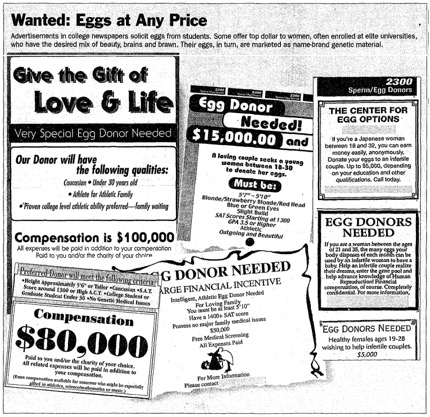
Figure 1: Multiple Egg Donation Advertisements, Los Angeles Times, May 2001.
As seen in the image above, advertisements with higher compensation rewarded being of Caucasian descent. This is a representative example that reflects the broader trend of attributing higher financial value to white traits. Characteristics described as desirable through their offering of up to hundreds of thousands often exclude women of color, thus excluding them from being compensated generously compared to their white peers. Regardless of a woman’s background, fertility clinics sought college women, as their priorities often centered on paying off the increasing cost of college tuition. By offering lucrative amounts of money during women’s limited window of donating from ages nineteen to twenty-nine, it competes with the sentiment of solely donating to help infertile families.

Figure 2: Increased compensation over time. Diane M. Tober, Eggonomics: The Global Market in Human Eggs and the Donors Who Supply Them (New York: Routledge, 2025), p 57.
The amount women can be compensated increased over time, showing the shift in sentiment of egg donation agencies seeking donors to donate for financial reasons.[3] While many may have felt compelled to donate their eggs out of altruism, they are offered thousands when they are often starting their careers and establishing households. The economy offered limited options for women in their early twenties, and this is preyed upon by fertility agencies that are also looking to appeal to intended parents who want highly educated donors. Fertility agencies connected potential donors with the opportunity to help a family and be paid tens of thousands, at the expense of donors potentially risking their long-term health. The transformation of advertising in the egg donation industry doesn’t just produce a donor profile; it reveals how economic systems prey on women’s bodies at the moment when they are the most fertile and financially precarious. With advances in technology, advertisements that once reached large audiences can now directly target college students through social media algorithms. Fertility clinics downplayed the risks of egg donation when advertising to potential egg donors, a pattern that holds for both the early and modern eras of egg donation. Even if they wanted to inform their registered donors properly, there is no study to cite on the long-term effects of egg donation on women’s bodies.[4] The lack of regulation on the advertisements of egg donation leads women to make decisions without being properly informed.[5] Women in their twenties are especially targeted in advertisements, with agencies adapting to the TikTok format to create relatable content set to trendy audio; this practice has led to their success. This marks the beginning of a contradiction in the meanings previously attached to egg donation, where altruism and mutuality are displaced by financial necessity.
A Case Study of YourEggs Approach to Advertising
YourEggs is a company that embodies the broader egg industry, as it innovates on multiple fronts and attracts donors through targeted advertising campaigns, without disclosing the risks of the procedure. It’s a valuable case study, as it was a company that innovated on industry advertising standards and had its approach mimicked by others. To understand YourEggs approach and shifting values and tactics of its social media campaigns, I categorized all 567 posts or reels into genres as of 23 May 2025.[6] Categorizations were created based on inferring the purpose of a post and what it was trying to accomplish, and the shifting genres of posts capture how the company’s advertising approach changed over time. Then, I tracked how the style of posts was created by creating a spreadsheet and tallied each post to fit into a category.[7] The style of posts changed over time, reflecting the company’s values at a given time. They can be depicted as a reflection because their social media is how they reach potential donors and intended parents, and to influence them to choose their agency specifically.

Figure 3: YourEggs (@YourEggs_), “Infertility is NOT an inconvenience…,” Instagram Photo, 14 September 2022.
In its initial social media presence from April 2021 to June 2023, YourEggs favored transparency about the process for hooking prospective parents and donors. Posts fell into the following top categories: informing donors, holiday posts, informing intended parents, faculty photos, mental/physical health posts, and photos of parents. With this style of posting to inform parents and donors, they received between 2 to 13 likes per post.[8] A view into what their posts consisted of is provided by an image of their Instagram page from this date range above. While informative, these posts were their sole means of advertisement on Instagram to both intended parents and donors. At the time, they did not emphasize compensation and instead were transparent about the donation process. The lack of engagement was not a detriment to YourEggs, as they were already successful as a company, with claims that they have the largest egg donor database. They were not innovating in their approach to advertising at the time, and instead simply informed people about the process.
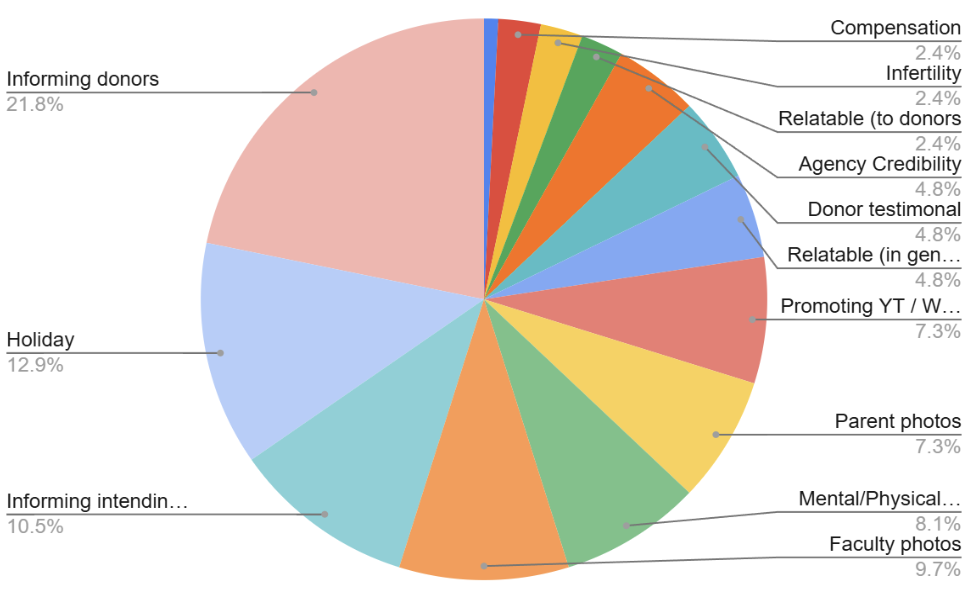
Figure 4: Analysis of categories of YourEggs Instagram Posts. Data from @Your Eggs_. Created by author using Google Sheets (2025).
People unfamiliar with the topic were not emotionally drawn to donate, as YourEggs mentioned; donating to help families struggling with infertility and financial compensation was the least mentioned in their posts, as noted in the graph above. They did not resonate with donors on Instagram or attract new ones, but they saw increased engagement after hiring a professional TikTok marketing expert.
The new marketing coordinator, Jamie Olney, joined in June 2023 and innovated on existing industry advertising standards by utilizing short-form content and trendy audio inspired by the format of TikTok. By embracing a new social media posting style, they finally resonated with their target audience: women in their twenties.

Figure 5: YourEggs’ first use of reels and trendy audio. YourEggs (@YourEggs_), “…because you can help a family AND get paid up to $6,000 each time!,” Instagram Photo, 5 May 2023.
Their very first reel was a huge success, getting 109 likes, the largest amount of likes that page had up until that point.[9] Even the background tells a story; the fertility clinic in the background isn’t YourEggs, it’s Gen 5 Fertility Center. This is because YourEggs is an agency, the middleman between clinics and their clients. The agency has a stake in the output of its advertising campaign; its ability to attract new donors benefits its affiliate clinics and would generate more profit opportunities. Their use of hashtags is likely utilized to land on the For You Page of potential donors.[10] In other posts, they have utilized hashtags with names of Ivy League universities, showing they were targeting those students specifically in their advertising campaign.
By using the reel format, YourEggs increased their engagement exponentially. Reels became very popular, reaching thousands to hundreds of thousands of likes and views. The first reel posted departed from their standard of posting to inform, as mentions of compensation had previously been the least-posted genre.
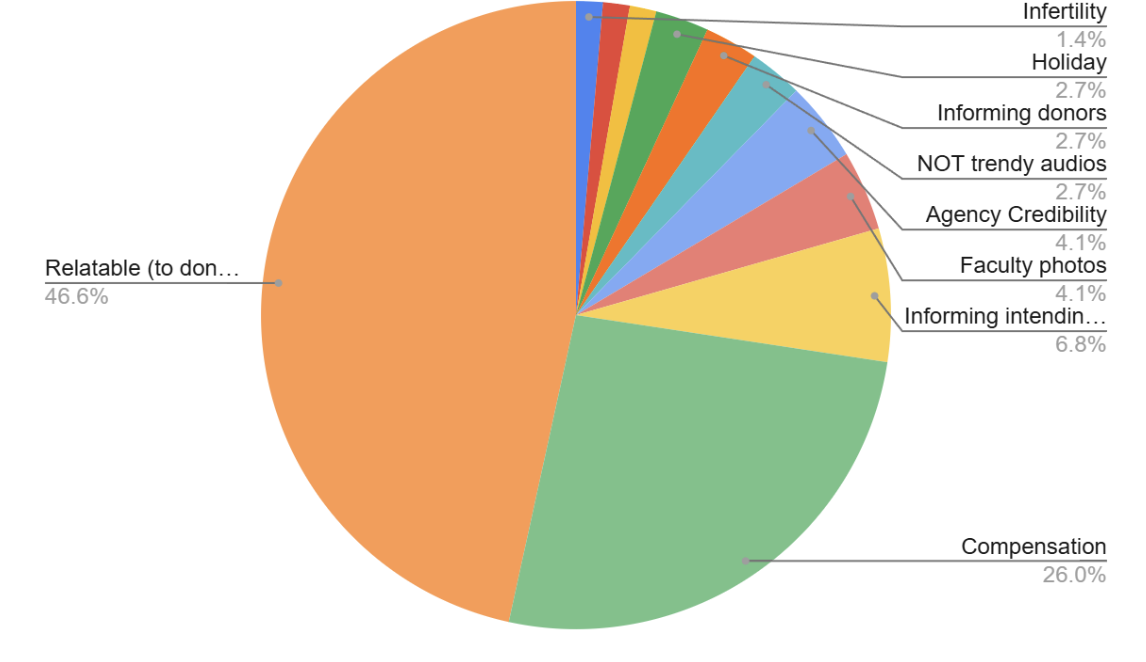
Figure 6: Analysis of categories of YourEggs Instagram reels. Data from @YourEggs_. Created by author using Google Sheets (2025).
The graph above shows the categorization of reels from June 2023 to January 2025.[11] This is distinct from the first era mentioned, as they changed their approach in advertising with their new marketing coordinator. While YourEggs continued to post regularly, their utilization of reels that attracted the most engagement best reflected their advertising rhetoric because this was their approach to attract new donors. Their shift from the previous approach demonstrates their innovation in creating mass engagement among social media users to attract more donors and grow their database. Most remarkably, YourEggs created a scenario of what the donor would experience if they decided to donate their eggs, promising compensation. This surge in engagement wasn’t only due to effective marketing, but also to the sale of a fantasy of financial independence through egg donation. These posts were no longer informative, as in their previous approach; they appealed to the donor’s likely economic vulnerability, and it worked. The very fantasizing is what made this campaign so successful. By providing the illusion of empowerment through the ability to earn money that can go toward a woman’s education or pressing bills, womanhood is a gain rather than a loss for existing in a system that consistently undervalues them. As YourEggs posts fantasy scenarios, the posts become harder to categorize. When the audio is the primary focus of the video, and its purpose is not to inform the donor, I categorize it as relatable because it puts the viewer in the scenario of it occurring.[12] It uses trendy audio that is often used on TikTok around the time it is posted to reach users outside of their usual following.

Figure 7: YourEggs most popular reel. YourEggs (@YourEggs_), “Let’s gooo!..,” Instagram Video, 7 December 2023.
The most popular reel followed this approach, reaching 317 thousand likes and seven million views.[13] Since it talks about the amount of money donors can earn from donating their eggs and the excitement of spending it, it is the epitome of the type of post that attracted many donors: one focused on economic independence. For women in their twenties, financial stipends are a lucrative opportunity when they’re not being told the risks of the procedure. Advertising in the form of content that college students regularly consume captures their attention and allows them to explore the website on their own.
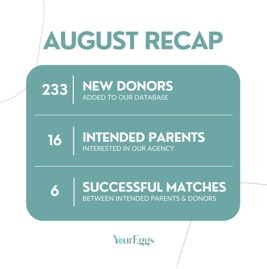
Figure 8: YourEggs post commemorating the number of donors added. YourEggs (@YourEggs_), “August was an amazing month for us, with many new faces!…,” Instagram Photo, 8 September 2023.
With a record number of donors added to the database after the campaign, it was clear that the TikTok campaign of creating relatable content to spark interest in potential college-aged donors was successful.[14] After going viral, this post about the number of donors showed that this approach successfully captured their ideal audience. For many, selling their eggs commodifies their reproductive capacity. Women’s fertility is one of the few avenues left for women to pursue economic advancement in a market diminishing in opportunities. Advertising campaigns highlight the money to be made and downplay the possible damage to a woman’s health. As seen in a post below, YourEggs comments on the diminishing number of eggs due to menstrual cycles and to use them for donation instead. The messaging suggests donating eggs “that would’ve otherwise gone to waste during your period,” is better because there is money to be made. Instead of losing eggs to periods, losing eggs for the sake of donation is framed as an economic gain, and not an invasive process of taking hormones and undergoing surgery.

Figure 9: YourEggs framing of lost eggs. YourEggs (@YourEggs_), “Alright, you convinced me…,” Instagram Video, 19 September 2023.
This messaging diminishes the damage done to women’s bodies, and instead highlights the economic opportunity, creating a fantasy of women having money in an economically vulnerable part of their lives. By utilizing this form of advertisement, it led to a significant increase in YourEggs donor registry. However, YourEggs’ success didn’t last forever: when the marketing coordinator responsible for the start of the short-form content campaign resigned, user engagement dropped significantly. The new coordinator of TikTok-style marketing was not as successful in terms of engagement, and moved to TikTok instead to post short-form content. The analysis of Instagram’s performance does not consider the potential success and engagement on TikTok, but with their recent posts of AI babies talking about how they were created by YourEggs symbolized that their attempts to create engagement with potential donors no longer worked. Likes on posts ranged from one to twelve, with only a few successful reels that never broke one hundred likes.[15] While YourEggs was successful, it was vulnerable to falling out of favor because relying on trends as a marketing strategy becomes fatiguing for consumers, who have to sort out actual relatable content from relatable content in the form of an ad. The shifting eras of YourEggs reveal more than changing marketing trends. The YourEggs Instagram solely emphasizing the amount women can be compensated through its most engaging form of content exposes how deregulated fertility agencies target financially vulnerable women by reducing the meaning surrounding the donation of eggs. In their reels, they mentioned altruism and positive feelings donors have when donating their eggs only a few times, compared to 72.6% of posts that were in a relatable format or emphasized the high amounts of compensation donors can potentially receive.
Egg Donation Agencies’ Approach to Advertising
Other competing agencies tried to mimic the short-form content format to achieve results similar to YourEggs. The Allure Fertility Center created reels similar to YourEggs after its success; however, they did not reach nearly as much engagement, reaching only two to five likes on reels.[16] Cofertility took a similar approach, targeting intended parents.[17] Overall, their posts focused more on their innovation in the egg donation industry and the strides made by the CEO. A post that strays from their previous posting patterns utilized the fame of Olympic gold medalist Alysa Liu to highlight the opportunity of egg donation for parents. The approach of capitalizing on cultural moments and general desires of intended parents demonstrates their aim to broaden their reach to target audiences.
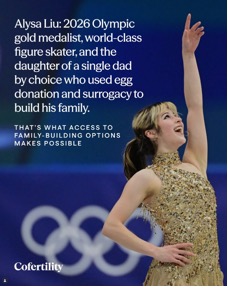
Figure 10: Cofertility post featuring Alysa Liu. Cofertility (@cofertility), “Alysa Liu just won Olympic gold in women’s figure skating…,” Instagram Photo, 21 February 2026.
Capitalizing on Alyssa Liu’s success, egg donation agencies invited parents to fantasize about more than simply wanting a child. Parents pursuing egg donation often already hope their child will live a successful and fulfilling life, but advertisements tied to recognizable cultural figures narrow that desire into specific and marketable traits. By associating egg donation with an Olympic gold medalist, agencies encourage parents to imagine not merely a baby, but the possibility of producing an exceptional child. In doing so, advertising shifts away from informing parents and donors about the medical process and instead markets aspiration and potential. Short-form content and culturally relevant moments function as entry points into the agency for both parents and donors, but also reshape how egg donation is understood. Considering the lack of long-term studies on egg donation and the absence of regulation surrounding fertility advertising, this content does not simply inform participants about reproductive options but sells idealized futures in the form of money, prestige, and imagined genetic potential. Rather than expanding understanding of egg donation, these campaigns narrow its meaning into a low-stakes exchange of bodily sacrifice for donors into financial gain. For parents, it narrows the desire of wanting their child to have a good life into seeking traits conducive for future success. This narrowing and evacuation of meaning in egg donation, formed through advertising, does not operate neutrally but influences which bodies are considered valuable in the market.
Perpetuating Racial Inequality through Preference
When intending parents choose an egg donor, they have to decide on the traits their child will have. It can vary from hair type, eye color, and, most notably, race. Many parents choose a donor of the same race for various reasons personal to them, but reveal a pattern present in the egg donation industry. Since White and East Asian couples are overrepresented in the upper-middle to upper class, they can afford the expensive process of conceiving a baby through egg donation.[18] They dominate the market as consumers and dictate which traits are financially valuable, depending on whether they align with their genetics or values. Even when preferences are satisfied, inequality persists in the form of the demand and compensation given to donors of color.
To demonstrate this sentiment, compensation for White and Asian donors can reach as high as $75,000–$100,000 vs. $12,000 for top Black donors.[19] Agencies, such as YourEggs, tailor their digital media to accommodate these intended parents by recruiting donors of those specific races and creating compensation tiers that give more compensation to donors based on their level of education.[20] Advertising does not merely reflect parental preference; it actively shapes and intensifies it by repeatedly presenting certain traits as desirable while omitting those of Hispanic and Black women.

Figure 11: YourEggs post seeking Ivy League donors. YourEggs (@YourEggs_), “Have you graduated from an Ivy League and are ready to begin your next adventure?,” Instagram Photo, 17 January 2024.
These tiers operate within racial categories as well, meaning donors are not only selected by race but ranked within it. For instance, “compensation for Ivy League egg donors typically starts at $30,000,” and this, in combination with other traits, can exceed 100,000.[21] Consumers who can afford egg donation have the opportunity to demand specific traits, such as education, in their baby. Such patterns define what donors are economically valuable, who is excluded, and reinforce racial stratification in what originated as a medical procedure practiced out of altruism.
Even when intended parents seek donors of their own race, the market structure does not produce equal valuations. Donors within the same race are differentiated by traits such as education prestige, education level, and physical appearance. These traits are themselves shaped by broader racial and socioeconomic inequalities. As a result, even within racially matched transactions, not all donors are valued equally, and compensation continues to reflect hierarchies tied to whiteness and elite status rather than simple supply and demand.
The lower compensation amounts for donors of color cannot be attributed to the large number of Black donors. In fact, “many Black women who need egg donors discover that Black donors are nearly impossible to find,” which is unsurprising because Black women “are not targeted with the promises of equally high compensation for the same physical process compared to White and East Asian women.”[22] With supply not meeting demand for Black egg donors, the lower compensation amounts cannot simply be attributed to demand; rather, they reflect a demand shaped by advertisements encouraging parents to choose their perfect baby by controlling traits such as eye color, education level, and race. If compensation were determined by supply and demand, the scarcity of Black egg donors would result in higher compensation. However, the opposite is true: valuation is not governed by market scarcity but by socially constructed desirability.
At the same time, available data suggest that white donors are also underrepresented relative to demand. A study conducted by the National Institute of Health found that, “While the absolute number of oocyte donors identifying as white was considerably higher than any other racial groups, the relative proportion was lower than that of United States women (43.1% vs. 54.8%, P<.001) and that of donor oocyte recipients.” Additionally, there was an underrepresentation of black women and an overrepresentation of Hispanic women relative to the population distribution.[23] One possible explanation is that white donors are underrepresented because they are selected more quickly due to higher demand, leading to faster turnover and reduced visibility in donor databases. In this case, the apparent presence of more donors of color does not represent oversupply, but rather differential demand and circulation within the market. This further complicates supply-based explanations of compensation disparities, as both scarcity and underrepresentation of white and Black women fail to produce higher valuation for all groups equally. Rather than reflecting neutral market dynamics dictated by supply and demand, these disparities reveal how valuation is shaped by socially constructed desirability, in which race serves as a proxy for imaginably desirable traits. In this way, the market does not respond to preference; it actively shapes it.
The sperm donation industry provides a useful comparison to analyze the disparity existing for Black egg donors: despite “difficulties with recruiting Black [sperm] donors,” they are “paid more or less the same regardless of their ancestry.”[24] This contrast isolates the key variable: while both industries experience difficulty in recruiting Black donors, only for egg donation does that translate into unequal compensation. If valuation were governed by supply and demand, Black egg donors would be paid more, but the opposite is true. Sperm donation facilities choose not to compensate Black donors more despite being more in demand, and egg donation facilities compensate Black donors less than their white counterparts. This contradiction demonstrates that valuation is not based on scarcity, bodily damage, or potential risks to long-term health or fertility; it is based on assigned social desirability rooted in whiteness and elitism. The relative equality in sperm donation shows that such disparities are not inevitable outcomes of the market, but the result of how egg donation agencies structure and market reproductive value.
The hierarchy doesn’t apply just to race, but also to the value of higher education. YourEggs made a post that advertised their Ivy League donors as “elite” and advertising compensation up to $120,000.[25] While Ivy League educations can be inaccessible for women of color due to their costs and the nature of standardized tests, the valuation of such donors to be higher perpetuates the lower income women of color are already subjected to. Ultimately, educational prestige overlaps with race to reinforce the rewarding of white tropes and model minority tropes. When egg donation agencies make education a criterion and a desired trait, it underscores the belief that someone with a Harvard-educated background will pass on genetic characteristics to their child, thereby increasing their child’s probability of success in education later. Idealized traits of being white or East Asian are packaged and sold as the gold standard, reducing the value of Black and Brown reproductive labor. While egg donation can be framed as empowering for helping infertile families, it is not immune to claims that it resembles modern-day eugenics because it reinforces existing racial and socioeconomic hierarchies by rewarding having traits of “the ideal donor.” For Black and Latina women who may look into donating, they eventually find that their traits of uniqueness are not considered financially valuable, and their bodies and background do not enable them to be a commodity of value.
Categorization of Egg Donors via Databases
When intended parents realize their desire to conceive a baby via egg donation, they may have certain traits in mind when deciding on a donor. Perhaps it’s having a shared race, eye color, heritage, or education level. But when they first log into a database to view potential donors, they are presented with a significant amount of information. The YourEggs donor database preview provides an inside view of what parents see when seeking a donor.[26]
The image below was obtained from the YourEggs database and has been anonymized to protect donor privacy, as access to these profiles requires user registration and is not intended for public view. Even in an anonymized view, the database reveals how donors are presented through standardized traits and curated images, reinforcing their treatment as comparable units. When parents view a donor profile, they first see the donor as an adult and can filter traits of race, eye color, hair color, parents’ ethnicities, education, height, weight, age, and location. When parents enter the process wanting to conceive a baby with certain traits, the variety of options available to them enables them to create the ideal baby.
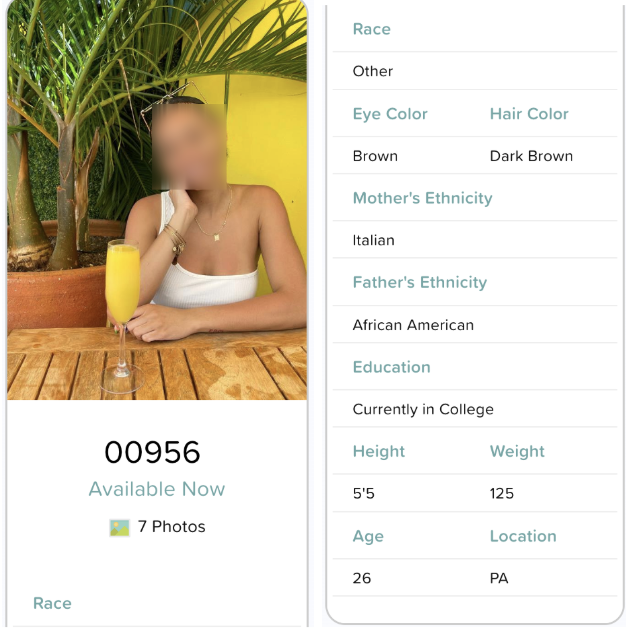
Figure 12: Donor profile from YourEggs database. YourEggs. “YourEggs: Trusted Egg Donation Bank & Egg Donors Agency.” https://youreggs.com/.
This is all they can see with a preview, and they can see a fuller profile if they email YourEgg directly. The sheer number of donors with diverse traits encourages parents to consider how to better accommodate their preferences. But instead of a baby that the parents were likely picturing when seeking an egg donation agency, they are met with a picture of an adult woman. Rather than imagining what a future child with the shared traits of the intended father would be like, parents must consider how the genetics would combine to produce, and also change the existing image of their head from an adult to a baby. It is important to note that many photos of egg donors in the database are posed to highlight the donors’ appearance. The agency and its donors are not selling the idea of a baby; instead, they invite parents to evaluate the donor through appearance and list of traits. This, along with the amount of information available to parents in the database’s preview version, leads them to evaluate the donor rather than a potential baby. While the donor is an essential component in conceiving a baby, they are evaluated in a state of advertising themselves through a curated photo to invite parents to seek their eggs for donation. They are subject to the criteria for evaluating an adult rather than the direct imagining possible with an image of them as a child. The mass amount of information parents get in a single viewing enables them to consider traits they may not have thought relevant before. With the ability to customize, they consider traits beyond their initial desires, based on donors’ characteristics and photos, when deciding whom to choose as a potential donor.
In providing large amounts of information for intended parents to consider regarding the thousands of available donors, some have a specific profile in mind. Some are willing to pay over $100,000 to pay for a donor of their desired race and education level, namely, an Ivy League education. Companies have incentives to give parents the ability to customize and choose their donor, as they are willing to pay more. With the abundance of information about individual donors, agencies are taking what parents want and intensifying it by mass-filtering donors by categories and including details such as location and weight. Additionally, they may be influenced by the photo of the donor’s presentation, given the vast number of readily available donors. Parents who come in, ambiguous about what they’re looking for, are influenced by the database; this draws them towards certain traits and prompts them to sort and select traits, reinforcing the broader shift towards the commodification of reproductive labor. In this way, the evacuation of meaning operates not only by reducing egg donation to a financial transaction, but also by structuring parental choice by providing donors, in their adult state, with a large amount of information before proceeding with donor selection.
Sperm Donor Database Comparison
To highlight how egg donation agencies shape parental preference through the categorization and presentation of donors, the presentation of sperm donor databases is important to consider. The profile under analysis is provided by the Fairfax Cryobank.[27] Before parents can even view the database, they can filter traits such as race, hair color, and eye color. Parents can choose to view donors with any traits or pick a select set of traits.
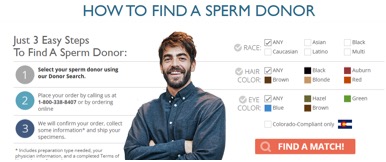
Figure 13: Database filters for sperm donors. Fairfax Cryobank – Find a Sperm Donor. “Donor Search.” https://fairfaxcryobank.com/.
When parents make their selection based on the prompts, they are presented with a database of sperm donors pictured as babies. Because parents can view only 6 categories at a time, they must be interested in a donor before learning more by clicking on their profile. Parents are also presented with the image of the donor as a baby, leading sperm donors to be evaluated as babies rather than adults, compared to their egg donor counterparts. While there is no required user registration and it’s publicly available, the photos in profiles have been anonymized to protect donor privacy.

Figure 14: Sperm donor profiles. Fairfax Cryobank – Find a Sperm Donor. “Donor Search.” https://fairfaxcryobank.com/.
While egg donation databases present women with extensive traits as adults, sperm donation databases limit the amount of information available upon the first viewing of a database. This difference is not cosmetic; it reflects two fundamentally different logics of reproductive valuation. For egg donors, parents are led to evaluate the donor based on the ten traits they initially see when scanning the database. Egg donor databases encourage parents to evaluate the donor as a fully formed individual, thereby reducing them to a set of ranked, comparable traits. Additionally, in their profiles, egg donors often pose for photos and present themselves in a favorable light. In contrast, sperm donors present themselves as they are, and may not be intentionally posing for the camera. In this way, egg donation platforms further evacuate the meaning of reproduction by transforming it into a process of selecting and optimizing traits, whereas sperm donation retains focus on the future child rather than the donor’s commodified body. The egg donor is not only a means to a child, but becomes the object of consumption itself. The database of donors does not simply organize information; it further narrows meaning by reducing donors to selectable traits, thereby transforming reproductive labor into sortable categories.
Conclusion
This paper has argued that social media advertising in the egg donation industry has narrowed the meaning of egg donation into a primarily economic transaction. Through advertising strategies, racialized compensation structures, and database design, egg donation is transformed from a relational and altruistic practice into a system of stratified valuation. These findings demonstrate that the market does not simply respond to demand, but shapes it by producing hierarchies of value rooted in race, education, and desirability. The lack of regulation on the messaging of advertisements, combined with the absence of long-term health data, enables agencies to market egg donation without fully accounting for its risks. The transformation of egg donation is not simply technological or economic, but also conceptual, redefining reproduction as a site of optimization, selection, and commodification. What appears as empowerment is truly a repackaging of systematic neglect, where their reproductive labor is only seen as valuable when it aligns with “elite” standards. At the same time, their bodies, and by extension their eggs, remain devalued. Ultimately, the contemporary egg donation industry does not simply commodify reproduction, but actively reorganizes how value, risk, and meaning are distributed across women’s bodies.
[1] Tatiana Arreola-Chavez is a sophomore at University of California Santa Barbara studying History and Philosophy. This paper grew out of their work from their freshman year in HIST 9. They are interested in histories of reconstruction and contemporary US history with a focus on gender and health. They plan to attend law school after graduation. Their friends also call them Finley.
[2] Kenneth Weiss, “Eggs Buy a College Education,” Los Angeles Times, 2001.
[3] Diane M. Tober, Eggonomics: The Global Market in Human Eggs and the Donors Who Supply Them. (New York: Routledge, 2025).
[4] Milenko Martinovich, “Uncovering the Long-Term Health Outcomes long-term for Egg Donors,” UCSF School of Nursing, 2020.
[5] Carpenter and Campo-Engelstein, “Egg donation advertisements: addressing the regulatory gap,” Springer Nature Link, 2025.
[6] YourEggs (@YourEggs_), Instagram Profile, https://www.instagram.com/youreggs_/following/.
[7] Tatiana Arreola, YourEggs Data Breakdown, Google Sheets, 23 May 2025, https://docs.google.com/spreadsheets/d/1IY9-1WU0av8VKn2m0yC7Euj_hkS0eLzVl6VVEU8YP2Q/edit?usp=sharing.
[8] YourEggs (@YourEggs_), Instagram Profile, https://www.instagram.com/youreggs_/following/.
[9] YourEggs (@YourEggs_), Instagram Profile, https://www.instagram.com/youreggs_/following/.
[10] “Hashtags in 2025. Do They Work?” American Marketing Association, 19 August2024.
[11] Tatiana Arreola, YourEggs Data Breakdown, Google Sheets, 23 May, 2025, https://docs.google.com/spreadsheets/d/1IY9-1WU0av8VKn2m0yC7Euj_hkS0eLzVl6VVEU8YP2Q/edit?usp=sharing.
[12] YourEggs (@YourEggs_), Instagram Profile, https://www.instagram.com/youreggs_/following/.
[13] YourEggs (@YourEggs_), Instagram Profile, https://www.instagram.com/youreggs_/following/.
[14]YourEggs (@YourEggs_), Instagram Profile, https://www.instagram.com/youreggs_/following/.
[15]YourEggs (@YourEggs_), Instagram Profile, https://www.instagram.com/youreggs_/following/.
[16] Allure Fertility (@Allure_Fertility),Instagram Profile, https://www.instagram.com/allure_fertility/.
[17] Cofertility (@Cofertility), Instagram Profile,https://www.instagram.com/cofertility/
[18] Richard Reeves and Nathan Joo, “White, still: The American upper middle class,” The Brookings Institution, 2017.
[19] Tober, Eggonomics, 2024.
[20] YourEggs_. Profile, Instagram https://www.instagram.com/youreggs_/following/.
[21] Encheng Cheng,“Egg Donation Cost in 2026: What Intended Parents Pay the Agency,” Ivy Surrogacy, 2026.
[22] Tober, Eggonomics, 2025.
[23] “Racial and ethnic disparities among donor oocyte banks in the United States,” National Library of Medicine, January 2022.
[24] Tober, Eggonomics, 2025.
[25] YourEggs (@YourEggs_), Instagram Profile, https://www.instagram.com/youreggs_/following/.
[26] YourEggs. “YourEggs: Trusted Egg Donation Bank & Egg Donors Agency.”May 2026 https://youreggs.com/.
[27] Fairfax Cryobank: The Trusted Choice for Donor Sperm, May 2026. https://fairfaxcryobank.com/.