Who Really Saved the B-Reactor? Reclaiming Dr. Chien-Shiung Wu’s Contribution to Hanford’s Survival
Megan Simpson
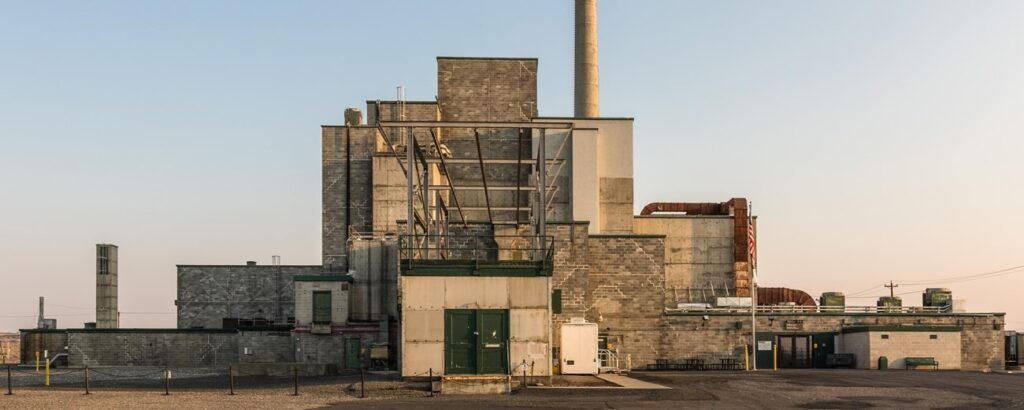
In late September of 1944, physicists at the Hanford Engineering Works faced a crisis that threatened to unravel one of the Manhattan Project’s most ambitious gambles. The B-Reactor: the world’s first full-scale plutonium production reactor, had gone critical at 10:48 pm on September 26th, but within hours its power plummeted. As a docent at the B-Reactor National Historical Landmark, I have told this story hundreds of times. Leona Woods Marshall (Libby), a physicist on Fermi’s team who was present during the failure, described what happened:
Something was wrong. The pile reactivity was steadily decreasing with time; the control rods had to be withdrawn continuously from the pile to hold it at 100 megawatts. The time came when the rods were completely withdrawn. The reactor power began to drop, down and down, until finally the reactor died.
Neutrons were disappearing into an unknown void, and Enrico Fermi, John Wheeler, and their team scrambled to find the cause. Their discovery of xenon poisoning became a landmark moment in nuclear engineering — but it was not made alone.
The version of this story told in official reports and memoirs, most notably The Uranium People by Dr. Leona Libby, credits Fermi and Wheeler for solving the problem. Yet her account relies on a particular definition of expertise: one that privileges physical presence and immediate response. Here, I argue that Dr. Chien-Shiung Wu’s prior research and wartime consultation were essential to that solution and that her absence from the official record reflects a broader pattern of erasure rather than insignificance.
Nearly 24 hours after the reactor first came online, it showed no signs of reactivity whatsoever. The engineers discussed this mystery with Fermi and the other physicists present, exchanging hypotheses. By early Thursday morning, the reactor had sprung back to life 24 hours after going down, only to plummet to zero reactivity 12 hours later.
John Wheeler, a Princeton University physicist serving as a consultant for DuPont, the civilian contractor of the Manhattan Project, was dispatched to Hanford and began closely following the second failure. As quoted by Richard Rhodes in The Making of the Atomic Bomb, Wheeler’s journals reveal that he had been “concerned for months about fission product poisons” and that he was convinced such a thing had occurred inside the B-Reactor. “A non-[neutron]-absorbing mother fission product of some hours’ half-life decays to a daughter dangerous to neutrons. This poison itself decays with a half-life of some hours into a third nuclear species, non-absorbing and possibly even stable,” Wheeler writes.
With Fermi gone for the night, Wheeler remained at the reactor, calculating probable half-lives based on the timing of the failure. By morning, he had concluded that two radioactive elements with a combined 15-hour half-life were responsible, according to Rhodes. Xenon-135, a byproduct of uranium fission, was absorbing neutrons faster than the reactor could produce them: a chain reaction becoming the instrument of its own destruction. The only solution was to increase the fuel rods to compensate. Yet accounts like this only reflect the surface of a much deeper intellectual network, one that includes Dr. Chien-Shiung Wu.

While Fermi, Wheeler, and their team at Hanford wrestled with the mysterious failure, Wu was 3,000 miles away in New York City, working in the Substitute Alloy Metals lab at Columbia University. Having earned her doctorate at UC Berkeley in 1940, Wu was part of the same scientific community as Fermi and Segrè during World War II. During her postgraduate research at Berkeley from 1939 to 1941, she studied neutron behavior in uranium fission, focusing on neutron absorption and its effects on chain reactions.
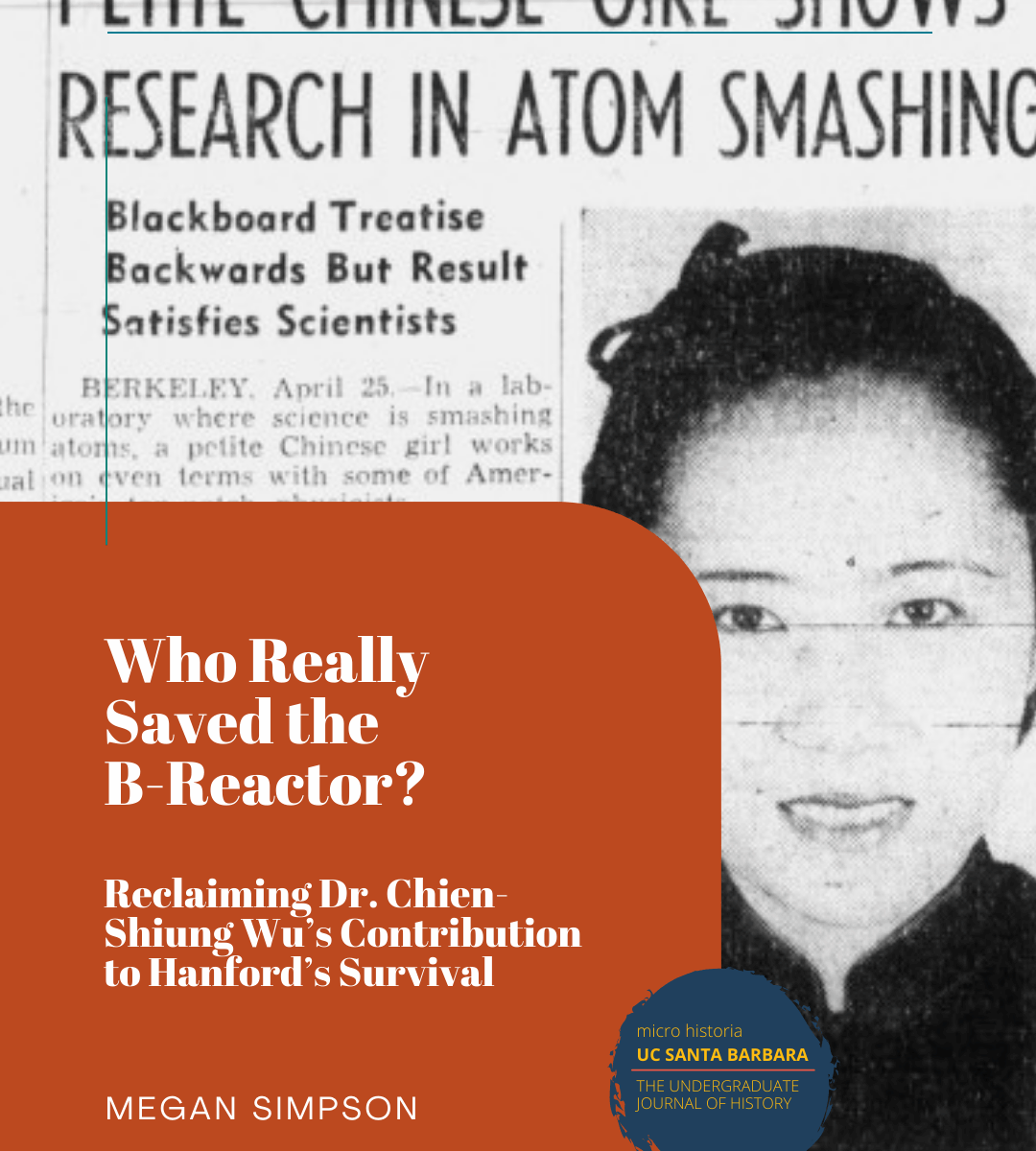
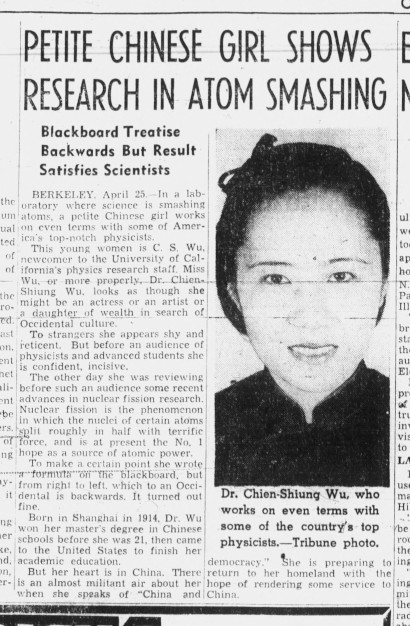
This work was significant enough to make the front page of the Oakland Tribune on April 25, 1941. That the headline read “Petite Chinese Girl Shows Research in Atom Smashing” says more about the era’s racial and gender biases than about Wu’s standing as a scientist; the article itself acknowledged that she worked on equal footing with some of America’s best physicists. Wu had already concluded that Iodine-135 and Xenon-135 could negatively affect a nuclear chain reaction, the same conclusion Wheeler and Fermi arrived at three years later. As Wu and Segrè wrote in “Radioactive Xenons,” “the time interval for accumulation of the radioactive gases in the emanating sample was always in the neighborhood of 12—24 hours.” This was precisely the timing window Wheeler had identified in the middle of the night at Hanford.
Wu’s research was conducted under the supervision of and co-authored with Dr. Emilio Segrè, one of Fermi’s closest friends and colleagues from their days in Rome. This research culminated in the paper “Radioactive Xenons,” published in the Physical Review in March 1945, which analyzed the neutron-absorption properties of fission fragments, findings that directly correlate with xenon poisoning. The publication date creates an obvious limitation: the paper was peer-reviewed and published six months after the B-Reactor crisis, meaning it cannot be cited as a direct source that Fermi consulted. What the timeline does support, however, is that the underlying research was mature and circulating within the scientific community well before publication, as was standard practice. Segrè, who maintained contact with both Wu and Fermi, was a conduit for these exchanges.
In her article “Discovering Dr. Wu,” Jada Yuan (Wu’s granddaughter) recounts how close-knit the physics community was with a story that highlights this connection: “Physics was a small world, and my grandmother kept company with the greats…When Enrico Fermi, who built the world’s first practical nuclear reactor (key to the Manhattan Project), became frustrated that it mysteriously kept shutting down, Segrè told him to “ask Miss Wu.” She confirmed his suspicion that xenon-135, a byproduct of nuclear fission, was poisoning the reactor.” Yuan’s account is familial rather than archival, and cannot serve as documentary proof of the consultation. What it does reflect are the informal intellectual networks of wartime that leave no paper trail. That Wu’s research independently arrived at the same conclusions as Fermi and Wheeler, through the same fission products and the same timing window, makes Yuan’s familial account historically plausible.
Visitors sometimes ask why Wu deserves credit when she was never in the control room. This is a fair question that gets to the heart of how we measure intellectual and historical contributions. Fermi and Wheeler diagnosed and solved the immediate crisis; that is not in dispute. But Wu’s research had already mapped the very phenomenon that was killing the reactor, and in a compartmentalized wartime project, calling her was as close to peer review as Fermi was going to get. Her work did not need to be in the room to matter.
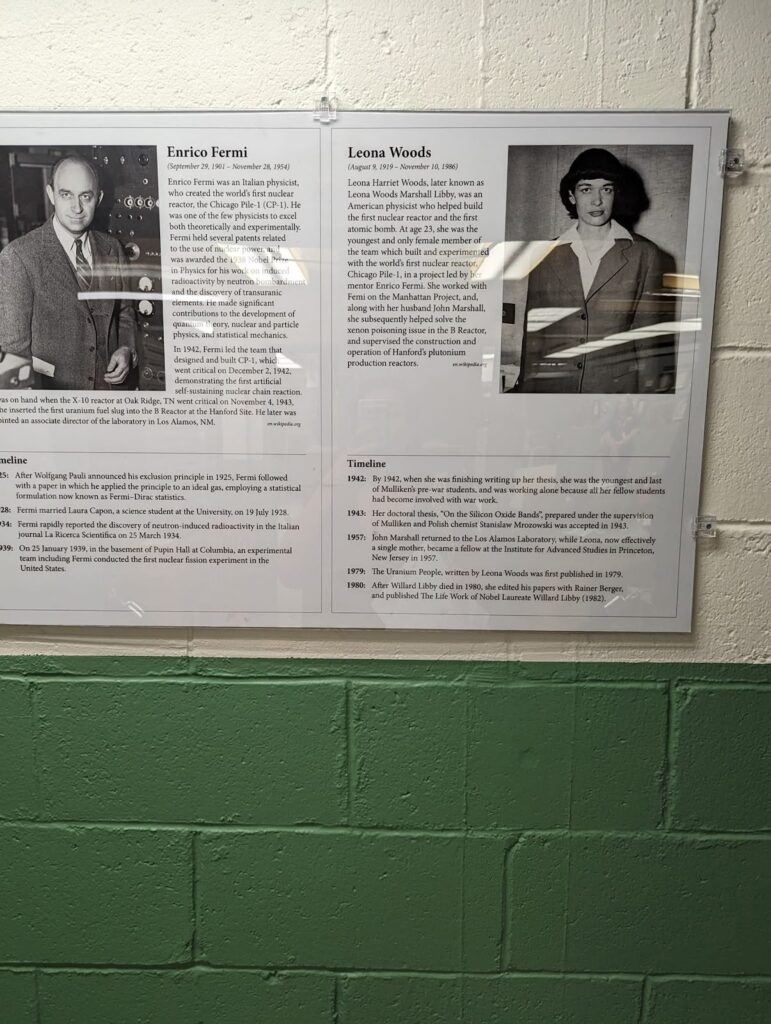
Within this network, Wu’s research was respected, referenced, and crucially relevant. Segrè’s advising Fermi to call Wu, knowing that three years earlier they had been researching the very thing now crippling the reactor, is consistent with the timeline of events as recounted by Yuan. Fermi and Segrè had worked together for years in Rome; Segre was Wu’s professor at Berkeley. Yet, when the story of the B-Reactor’s mysterious failure entered the official record, Wu’s contribution was absent.
“From the dynamic behavior of the growth and decay of pile reactivity, Fermi, Wheeler, Hughes, and I evaluated the cross section of xenon as being incredibly 30,000 times larger than that of uranium”, Libby wrote in The Uranium People. “From this, Fermi calculated that if all the extra holes of the reactors were loaded with uranium slugs, the reactors would have enough reactivity for successful operation.” Libby was herself a woman working in a male-dominated field, and the inclusion of her name in her memoir was an act of historical reclamation. Yet her memoir’s silence on Wu reminds us that exclusion can operate even among those who have experienced it. This selective storytelling reveals how history can privilege the visible, male, on-site figures over peripheral contributors whose insights make those solutions possible.
Despite being recognized by her colleagues and mentors as a leading authority on beta decay, Wu does not appear in the widely accepted contemporary narratives. The Making of the Atomic Bomb is Richard Rhodes’ seminal work, Pulitzer Prize-winning and regarded as the definitive history of the Manhattan Project. This is further compounded by other historical documentation, such as the Historic American Engineering Record of the B-Reactor, which relies heavily on Rhodes to convey the human aspect of the site’s history.
This pattern of crediting the visible, male, on-site figures while erasing the peripheral contributors whose work made the solution possible is one that Wu’s story makes impossible to ignore. As a docent at the B-Reactor 81 years later, I am working to ensure that she is not forgotten. The official history is polished and compelling; without her contribution, it is incomplete. Wu’s research provided the intellectual foundation for identifying xenon poisoning, and the network that carried her findings to Hanford deserves to be part of the historical record. Reclaiming her place is not revisionism; it is restoration. She deserves credit for her part in saving the B-Reactor.
Author Bio: Megan Simpson is a history major currently studying at Columbia Basin College, whose area of interest is the crossroads between nuclear history and women’s history. She is a docent at the Manhattan Project National Historical Park-Hanford Unit and an emerging public historian, committed to making history accessible to the public.